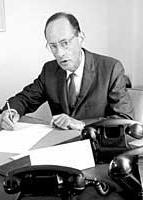
PHILIP FISHER
Father of growth investing who held Motorola for 50 years
Warren Buffett says he's "85% Benjamin Graham and 15% Phil Fisher." That 15% is doing a lot of heavy lifting. Fisher wrote "Common Stocks and Uncommon Profits" in 1958 and basically invented growth investing. He bought Motorola in 1955 and held it until he died in 2004 — 49 years. One stock. Nearly five decades. That's not a trade. That's a marriage.
Net Worth
$70 million (at death)
Nationality
American
Time Horizon
Generational
Risk Appetite
5 / 10
CAREER & BACKGROUND
Born in 1907 in San Francisco. Started his investment counseling firm Fisher & Company in 1931 — during the Great Depression.
He was 24. For the next 68 years, he managed money for a small group of wealthy clients, never advertising, never seeking publicity.
Fisher developed the "scuttlebutt" method of investment research — talking to a company's customers, competitors, suppliers, and former employees to understand the real story behind the numbers. This was radical in the 1950s when most investors just read financial statements.
He was Buffett's first growth investing influence. Before Fisher, Buffett was a pure Graham disciple buying cigar-butt stocks.
Fisher showed him that paying a fair price for an extraordinary business was better than paying a bargain price for a mediocre one.
COMPANIES & ROLES
Fisher & Company was his one-man advisory firm. He ran it from 1931 until retiring in 1999 at age 91.
He managed money for a select group of clients and never grew the firm beyond a handful of employees.
His most famous investments were in technology companies before tech investing was a category: Motorola, Texas Instruments, Dow Chemical, and FMC Corporation. He was investing in innovation when Wall Street was focused on railroads and steel.
His son Ken Fisher founded Fisher Investments, which grew into one of the largest independent wealth management firms in the world with over $200 billion in assets.
INVESTING STYLE & PHILOSOPHY
Fisher focused exclusively on quality growth companies. His "15 Points to Look for in a Common Stock" — published in 1958 — is still one of the best investment checklists ever created.
He looked for: above-average sales growth, high profit margins, strong R&D spending, excellent management, and sustainable competitive advantages.
He bought very few stocks — typically 10-30 at most — and held them for decades. He believed the best time to sell was "almost never." His Motorola position lasted 49 years.
The scuttlebutt method was his edge. He would spend months researching a single company before buying a share.
He'd talk to everyone in the industry. By the time he invested, he knew the company better than most people on its board.
THE PLAYBOOK
Risk Approach
Moderate. Fisher concentrated in a small number of stocks, which is inherently risky.
But he managed this through exhaustive research. He only bought after months of investigation, which reduced the risk of being wrong.
He was comfortable holding through market crashes because he trusted his research. If the business hadn't changed, a lower stock price was just noise.
Money Habits
Extremely modest. Fisher never sought wealth for its own sake.
He lived in San Mateo, California, drove ordinary cars, and spent his time reading and researching companies. His idea of a good time was visiting a factory.
He didn't seek publicity, didn't do interviews, and discouraged his clients from talking about his performance. He wanted to be left alone to think and invest.
BIGGEST WIN
Motorola. Fisher bought shares in 1955 when it was primarily a radio and television company.
He held through its transformation into a semiconductor company, then a cell phone company. His cost basis was so low that the position grew to represent a massive portion of his portfolio.
The compound returns over 49 years were astronomical.
BIGGEST MISTAKE
Fisher was so focused on buy-and-hold that he rarely admitted mistakes. His biggest acknowledged error was buying a company called Food Machinery Corporation (later FMC Corp) without doing enough research.
He said he was rushed and didn't follow his own scuttlebutt method. The investment underperformed, and he used it as a teaching example about the cost of shortcuts.
FINANCIAL PHILOSOPHY
Fisher believed the greatest investments are companies doing things that haven't been done before. Innovation creates the widest moats.
A company that's inventing the future has an advantage that no amount of financial engineering can replicate.
He also believed that time is the friend of the great business. Selling a wonderful company to buy a slightly cheaper mediocre one is always a mistake.
The tax friction alone makes frequent trading destructive.
His famous line: "The stock market is filled with individuals who know the price of everything, but the value of nothing."
FAMILY & PERSONAL LIFE
His son Ken Fisher became a famous investor in his own right — founding Fisher Investments and writing the "Portfolio Strategy" column for Forbes for 32 years. Phil Fisher died in 2004 at age 96.
His late years were affected by dementia. Ken has spoken publicly about his father's legacy and continued his scuttlebutt tradition.
EDUCATION
Born in San Francisco. Attended Stanford University, then Stanford Business School.
Left without completing his graduate degree to start investing. He was briefly an analyst at a bank before striking out on his own at age 24.
BOOKS & RESOURCES
As an Amazon Associate, Netfigo earns from qualifying purchases. Book links above may be affiliate links.
QUOTES (6)
Doing what everybody else is doing at the same time that everybody else is doing it is a formula for disaster.
The stock market is filled with individuals who know the price of everything, but the value of nothing.
Go to five companies in an industry, ask each of them intelligent questions about the other four, and nine times out of ten a detailed picture of all five will emerge.
NETFIGO SCORE
Proprietary 5-dimension investor rating
Risk Appetite
Contrarian Index
Track Record
Accessibility
Time Horizon
Related Profiles
Head-to-Head
Compare Philip Fisher vs another investor.