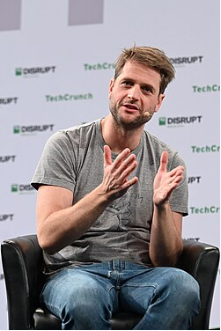
SEBASTIAN SIEMIATKOWSKI
Co-founded Klarna, the buy-now-pay-later giant that convinced a generation to split purchases into four payments.
The man who made "pay later" sound sophisticated instead of what it actually is — a prettier version of layaway with a Swedish accent. Klarna hit a $46 billion valuation in 2021, crashed to $6.7 billion in 2022, then clawed its way back to go public. Siemiatkowski went from fintech visionary to cautionary tale and back to visionary in three years. Say what you want about the model, but the man does not stay down.
Net Worth
$3.5 billion
Nationality
Swedish
Time Horizon
Long-Term
Risk Appetite
8 / 10
CAREER & BACKGROUND
Born in Stockholm in 1981 to Bosnian immigrant parents. His mother cleaned houses.
His father drove a taxi. Siemiatkowski studied at the Stockholm School of Economics, where he and two friends — Niklas Adalberth and Victor Jacobsson — pitched "let people buy now and pay later online" at an entrepreneurship competition.
They lost. The judges thought it was a terrible idea.
He built Klarna anyway. Founded in 2005, the company grew slowly across Scandinavia before hitting escape velocity in the mid-2010s as e-commerce exploded globally.
By 2021, Klarna was processing $80 billion in transactions annually across 45 countries with 150 million users.
Then came 2022. Rising interest rates destroyed the economics of buy-now-pay-later.
Klarna raised at $6.7 billion — down 85% from $46 billion. It was the most public humiliation in European fintech history.
Siemiatkowski responded by cutting 10% of staff, replacing hundreds of customer service agents with AI, and turning the company profitable. Klarna filed for its US IPO in late 2024.
COMPANIES & ROLES
Co-founded Klarna in 2005. Grew it from a three-person Stockholm startup to a global payments company with 150+ million users across 45 countries.
Klarna partners with 500,000+ merchants and offers buy-now-pay-later, direct payments, and a full shopping app. Under his watch, Klarna became one of the first major companies to publicly use AI to replace human customer service agents — their AI assistant handled two-thirds of all service chats within a month of launch.
INVESTING STYLE & PHILOSOPHY
Siemiatkowski is a builder, not a public markets investor. His wealth is almost entirely tied to his Klarna stake.
His approach to business mirrors growth investing with extreme conviction — bet everything on one idea, scale globally, worry about profitability later. He is deeply influenced by the Amazon playbook: grow fast, dominate the category, and let margins come when you own the market.
THE PLAYBOOK
Risk Approach
Extremely high. He took a company through an 85% valuation haircut and treated it like a speed bump.
He went all-in on AI replacing human workers when most CEOs were still writing careful memos about "augmenting" employees. His entire net worth has been tied to a single company for two decades.
Money Habits
Lives in Stockholm, not in a tech hub bubble. Known for dressing in bright colors and sneakers — not your typical Swedish banker aesthetic.
When Klarna's valuation cratered, he posted a selfie comparing himself to the "this is fine" dog-in-fire meme. Drives a Tesla, not a supercar.
Takes the same commute to Klarna's Stockholm office he has taken for nearly 20 years.
BIGGEST WIN
Building Klarna from a rejected pitch competition entry into Europe's most valuable fintech startup. At its 2021 peak, Klarna was worth $46 billion — more than Deutsche Bank.
Even after the crash, the recovery to profitability and a US IPO filing proved the model works.
BIGGEST MISTAKE
The 2022 down-round. Klarna raised at $6.7 billion after being worth $46 billion just a year earlier — an 85% drop.
The company had expanded too aggressively, credit losses spiked, and the zero-interest-rate environment that made BNPL economics work evaporated overnight. Siemiatkowski admitted they hired too fast and burned too much cash.
FINANCIAL PHILOSOPHY
Growth at all costs — until the market stops paying for growth, then pivot to profitability overnight. Siemiatkowski proved he can play both games.
He has publicly said the BNPL model is not about lending — it is about owning the checkout experience. Whether you believe that distinction matters is up to you, but it has been worth billions.
FAMILY & PERSONAL LIFE
Married with three children. Parents emigrated from Bosnia to Sweden before the war.
His mother worked as a cleaner and his father drove a taxi — a background he references frequently when discussing financial inclusion. "I grew up knowing what it's like to not have money.
That's why I built a product for people who need to manage their money carefully."
EDUCATION
Stockholm School of Economics (BSc in Economics). The same school where he pitched Klarna and was told it would not work.
He has since been invited back as a guest speaker, which is the most satisfying possible revenge.
BOOKS & RESOURCES
A founder's memoir that does not sugarcoat the near-death moments
Siemiatkowski recommended it during Klarna's own hard times
The Netflix culture book that influenced Klarna's internal playbook
As an Amazon Associate, Netfigo earns from qualifying purchases. Book links above may be affiliate links.
QUOTES (5)
I grew up knowing what it's like to not have money. That's why I built a product for people who need to manage their money carefully.
AI is not going to replace all jobs. But it is going to replace a lot of jobs that people pretend it won't.
A down-round is not a death sentence. It's a reality check. What you do after the reality check is what defines you.
NETFIGO SCORE
Proprietary 5-dimension investor rating
Risk Appetite
Contrarian Index
Track Record
Accessibility
Time Horizon
Related Profiles
Companies
Head-to-Head
Compare Sebastian Siemiatkowski vs another investor.