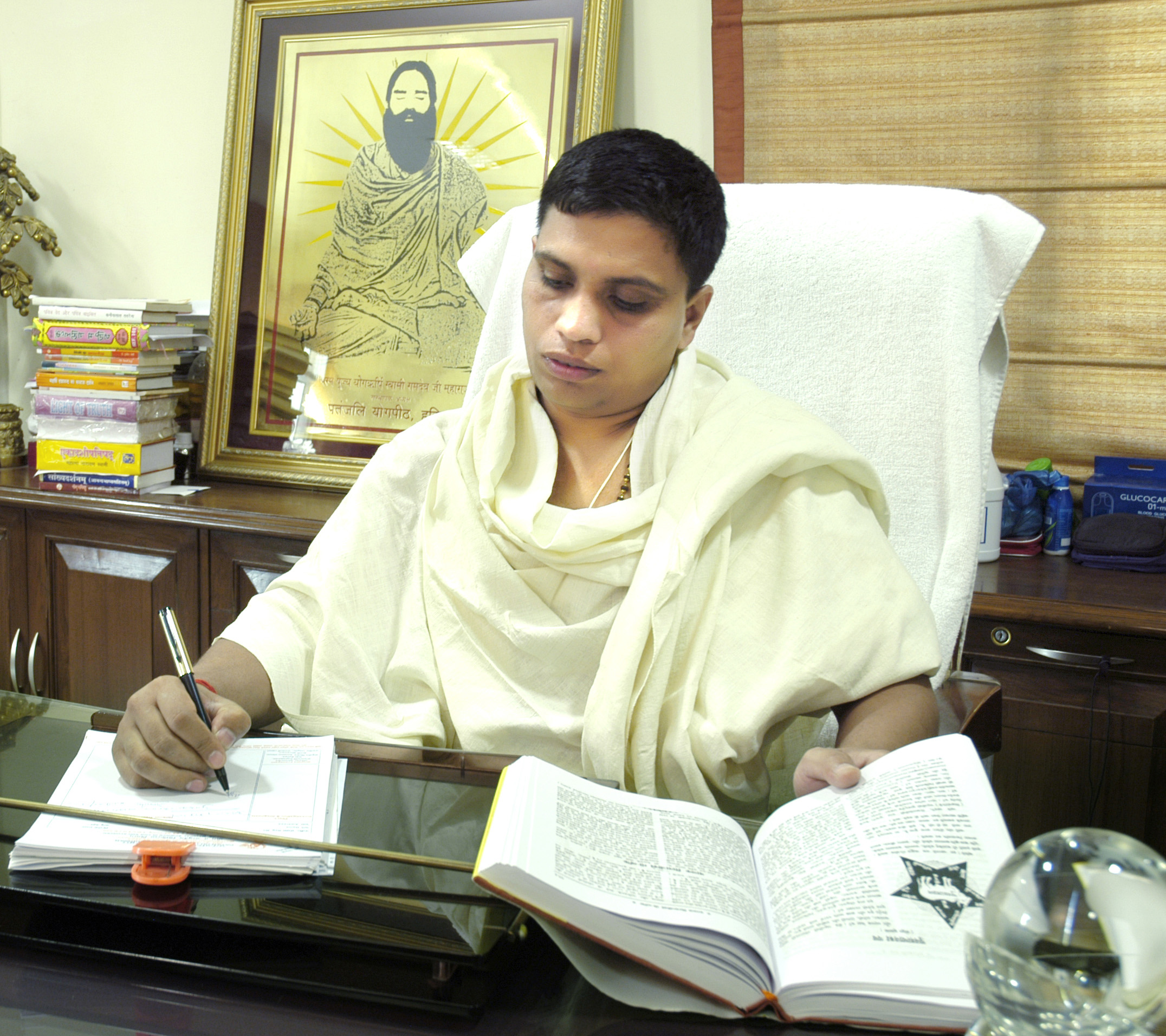
ACHARYA BALKRISHNA
Co-founder of Patanjali Ayurved who built India’s fastest-growing FMCG company alongside yoga guru Baba Ramdev
Acharya Balkrishna owns 94% of Patanjali Ayurved, the company that convinced a billion Indians to buy toothpaste made with neem and turmeric instead of Colgate. He’s worth $3.5 billion because he figured out that the world’s largest democracy would pay premium prices for ancient Ayurvedic remedies packaged in modern plastic. A monk who became a billionaire by selling herbal shampoo. That’s peak India.
Net Worth
$3.5 billion
Nationality
Indian
Time Horizon
Generational
Risk Appetite
8 / 10
Net Worth Context
- · Still a billionaire — just the quiet kind at the end of the table.
CAREER & BACKGROUND
Balkrishna grew up studying Ayurveda and Sanskrit in traditional Indian gurukuls (residential schools). He met Baba Ramdev in the 1990s and the two formed a partnership that would reshape Indian consumer goods.
In 2006, they co-founded Patanjali Ayurved. The pitch was simple: Ayurvedic products that were natural, Indian, and cheaper than multinational alternatives.
Ramdev provided the celebrity and the yoga empire’s distribution network. Balkrishna provided the business acumen and held the equity.
Patanjali exploded. By 2018, it was doing over $1.5 billion in annual revenue, competing directly with Hindustan Unilever, Colgate, and P&G.
The product range expanded from herbal remedies to toothpaste, noodles, biscuits, cooking oil, cosmetics, and cleaning products.
Balkrishna’s 94% ownership stake made him one of the richest people in India. The company’s growth was fueled by India’s swadeshi (self-reliance) movement and Ramdev’s massive following of yoga devotees who trusted anything with the Patanjali label.
COMPANIES & ROLES
Patanjali Ayurved is the flagship — an FMCG giant selling everything from toothpaste to cooking oil, all branded as Ayurvedic and natural. Revenue peaked at over $1.5 billion.
Ruchi Soya (now Patanjali Foods) was acquired in 2019 through an insolvency process for about $600 million. It’s one of India’s largest edible oil companies.
The acquisition gave Patanjali massive manufacturing and distribution scale.
Divya Pharmacy is the group’s traditional Ayurvedic medicine arm, selling herbal remedies and health products. It predates Patanjali Ayurved and was the original business.
INVESTING STYLE & PHILOSOPHY
Balkrishna isn’t a financial investor in the traditional sense. He’s a business builder who identified a massive gap in the Indian market — the desire for natural, domestic alternatives to multinational consumer products.
His investment is 100% concentrated in Patanjali and its extensions.
The growth strategy relies on two pillars: Baba Ramdev’s celebrity endorsement (essentially free marketing through yoga camps attended by millions) and aggressive price undercutting of multinationals.
THE PLAYBOOK
Risk Approach
Very high. Having 94% of your net worth in a single company is about as concentrated as it gets.
Patanjali faces regulatory risks, quality control challenges, and the constant threat that multinational competitors will fight back. The Ruchi Soya acquisition added debt risk.
Balkrishna accepted all of this because the upside of owning India’s fastest-growing consumer brand was enormous.
Money Habits
Despite being worth $3.5 billion, Balkrishna reportedly lives modestly, consistent with his Ayurvedic and spiritual lifestyle. He wears traditional Indian clothing, doesn’t flaunt luxury goods, and presents himself as a simple person dedicated to Ayurveda.
Whether this is genuine simplicity or strategic brand management is debatable.
His wealth is almost entirely paper wealth — the 94% stake in Patanjali. Liquidating it would be practically impossible without collapsing the company’s stock.
BIGGEST WIN
Building Patanjali from zero to $1.5 billion in revenue in barely a decade. The company forced multinational giants like Colgate and HUL to launch their own Ayurvedic product lines — a testament to how thoroughly Patanjali disrupted the market.
The Ruchi Soya acquisition was also brilliant — bought through insolvency for a fraction of its real value, it gave Patanjali the cooking oil market overnight.
BIGGEST MISTAKE
Patanjali’s quality control has been repeatedly questioned. In 2024, the Indian Supreme Court reprimanded Patanjali for making misleading health claims about its products, calling the advertising irresponsible.
The company was forced to apologize publicly. Revenue growth has slowed significantly since the 2018 peak, and competition from multinationals launching their own natural product lines has intensified.
The rapid expansion into too many product categories diluted focus. Patanjali noodles, Patanjali jeans, Patanjali SIM cards — the brand extension went too far, too fast.
FINANCIAL PHILOSOPHY
Balkrishna’s philosophy is rooted in swadeshi — Indian economic self-reliance. He believes Indian consumers should buy Indian products, and that ancient Ayurvedic knowledge can be commercialized at scale.
The financial model is simple: underprice multinationals, use Ramdev’s free marketing, and reinvest profits into manufacturing capacity.
It’s not sophisticated finance. It’s good old-fashioned business building with a cultural movement behind it.
FAMILY & PERSONAL LIFE
Balkrishna is unmarried and presents himself as an ascetic devoted to Ayurveda and education. His partnership with Baba Ramdev is the central relationship in his public life.
He holds degrees in Ayurvedic medicine and Sanskrit and maintains a scholarly identity alongside his business role.
EDUCATION
Traditional gurukul education in Sanskrit and Ayurveda. He holds a degree in Ayurvedic medicine.
His education is entirely outside the Western business school tradition — which is part of the Patanjali brand story. No MBA.
No finance degree. Just ancient Indian knowledge, commercialized at modern scale.
BOOKS & RESOURCES
As an Amazon Associate, Netfigo earns from qualifying purchases. Book links above may be affiliate links.
QUOTES (5)
Ayurveda is not alternative medicine. It is the original medicine. Everything else is the alternative.
India doesn’t need to import toothpaste. We have neem trees. We have turmeric. We have 5,000 years of knowledge.
A monk owning a company confuses people. But someone has to commercialize India’s ancient knowledge. Why not us?
Multinationals have marketing budgets. We have Ramdev’s yoga camps. Guess which one reaches more Indians.
NETFIGO SCORE
Proprietary 5-dimension investor rating
Risk Appetite
Contrarian Index
Track Record
Accessibility
Time Horizon
Related Profiles
Head-to-Head
Compare Acharya Balkrishna vs another investor.