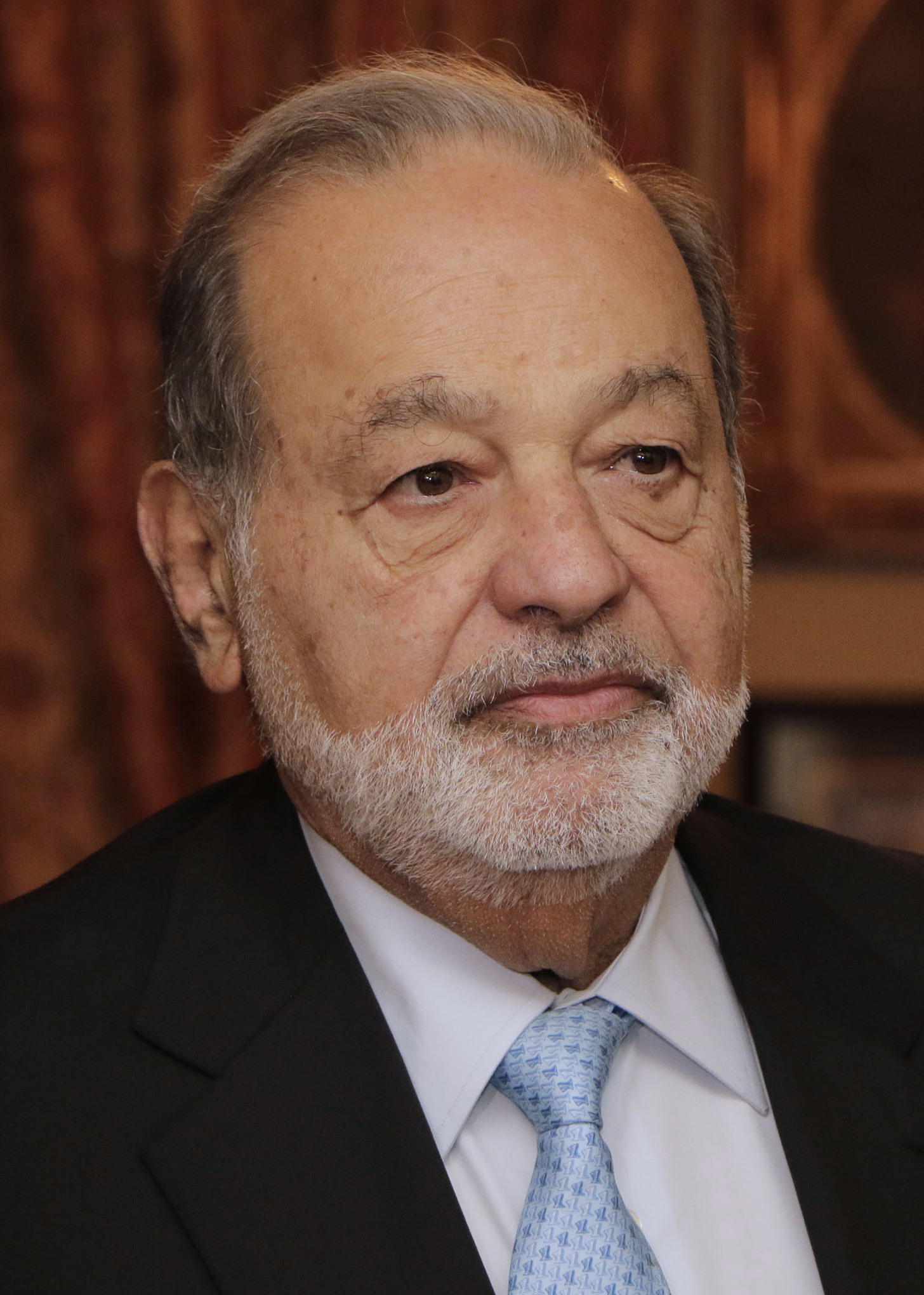
CARLOS SLIM
Was the richest person on Earth from 2010-2013. Built Telmex and America Movil into Latin America's dominant telecom empire.
He bought Mexico's phone company during privatization for $1.7 billion and turned it into a $60 billion empire that controls over 70 percent of Mexico's landlines and 70 percent of its mobile market. For three years he was richer than Bill Gates and Warren Buffett. The man basically charges every Mexican a tax for communicating. That is not investing genius. That is a monopoly. And it works.
Net Worth
$85 billion
Nationality
Mexican
Time Horizon
Generational
Risk Appetite
8 / 10
Net Worth Context
- · That's the GDP of a small country — around the size of Jamaica.
- · Enough to buy an NBA team and keep $81B for snacks.
CAREER & BACKGROUND
Carlos Slim started investing at age 11. He bought shares in a Mexican bank and kept a detailed ledger of every transaction.
By his twenties he was running a brokerage firm. By his thirties he was buying entire companies during Mexico's economic crises.
The defining moment came in 1990 when the Mexican government privatized Telmex, the national telephone monopoly. Slim's consortium bought it for $1.7 billion.
He immediately began expanding the network and raising prices. Within a decade, Telmex was printing cash.
He then spun off the mobile division into America Movil in 2000. It grew into the largest wireless carrier in Latin America with over 300 million subscribers across 18 countries.
At its peak, America Movil generated over $50 billion in annual revenue.
In 2010, Forbes named Slim the richest person in the world with a net worth of $53.5 billion. He held that title until 2013.
His fortune peaked during a period when Mexican telecom regulation was virtually non-existent.
COMPANIES & ROLES
Grupo Carso (founder/chairman), Telmex (owner), America Movil (chairman), Inbursa (banking), Sanborns (retail), New York Times (major shareholder)
INVESTING STYLE & PHILOSOPHY
Slim buys during crises. Every major Mexican economic disaster became his shopping spree.
The 1982 debt crisis, the 1994 peso crash, the 2008 financial crisis. When everyone else panics and sells, Slim buys controlling stakes in fundamentally sound businesses at distressed prices.
He focuses on businesses with high barriers to entry. Telecom, infrastructure, retail, banking.
Things that require massive capital investment and government relationships. Once you control the network, competition cannot easily enter.
He does not diversify globally the way most billionaires do. Over 90 percent of his wealth is tied to Latin American assets.
He believes the region's demographics and growing middle class will compound his returns for decades.
THE PLAYBOOK
Risk Approach
High. He makes enormous concentrated bets during crises when everyone else is running.
But he buys monopoly-like positions with massive cash flows, which reduces the actual downside significantly. The risk is political.
Governments can regulate or break up monopolies, and Mexico eventually did force Telmex to share infrastructure.
Money Habits
Despite being worth $85 billion, Slim lives in the same house in Mexico City that he has owned for decades. He does not own a yacht.
He drives a Mercedes but not the newest model. He wears a basic wristwatch.
He eats at his favorite Mexican restaurants. He is the anti-flashy billionaire.
His main luxury is art. He built the Museo Soumaya in Mexico City, named after his late wife.
It houses over 66,000 works of art including pieces by Rodin, Dali, and Rivera. Admission is free.
BIGGEST WIN
Buying Telmex for $1.7 billion in 1990. It became worth over $60 billion.
That single purchase created one of the largest fortunes in human history. He paid less than 2 percent of what the asset would eventually be worth.
No other single investment in Latin American history has generated more personal wealth.
BIGGEST MISTAKE
He held onto his Telmex monopoly position too aggressively for too long. Mexican regulators finally cracked down in 2014 with new telecom laws that forced Telmex and America Movil to share their network infrastructure with competitors.
The regulatory changes cost him billions in market value. If he had voluntarily opened up competition earlier, he might have avoided the government intervention that damaged both companies.
FINANCIAL PHILOSOPHY
Invest during crises. Sell during euphoria.
It is a classic contrarian philosophy but Slim executes it at a scale that few others can match because he always keeps cash reserves ready to deploy. He calls it his permanent appetite for investment.
He also believes in simplicity. He does not use complex financial instruments or derivatives.
He buys equity stakes in companies he understands and holds them for decades. He famously said investing is about reality, not about what people think about reality.
FAMILY & PERSONAL LIFE
His wife Soumaya Domit died of kidney disease in 1999. He never remarried.
He has six children, all of whom hold senior positions in Grupo Carso companies. Carlos Slim Domit runs America Movil.
The entire empire is a family operation.
EDUCATION
He studied civil engineering at the National Autonomous University of Mexico (UNAM). He also taught algebra and linear programming at UNAM while building his business empire.
He credits mathematics with teaching him how to think about value.
BOOKS & RESOURCES
It provides his perspective on every major deal and crisis he navigated
Covers the American industrialists who built monopoly positions similar to what Slim built in Mexico. Rockefeller, Carnegie, and Morgan. The parallels are obvious
Explains the economic conditions in developing countries that allowed entrepreneurs like Slim to build such dominant positions during privatization waves
As an Amazon Associate, Netfigo earns from qualifying purchases. Book links above may be affiliate links.
QUOTES (5)
The best investment is not the one that gives you the highest return. It is the one that gives you control over a market.
Wealth is not about accumulating money. It is about building things that employ people and serve society. The money is a byproduct.
When there is a crisis, that is when you invest. When everyone is afraid, that is when the opportunities are greatest.
I bought Telmex for $1.7 billion. People thought I was crazy. Now it is worth more than the GDP of most Central American countries.
I do not invest in what I cannot understand. I invest in things people need every day. Phone calls. Food. Infrastructure.
NETFIGO SCORE
Proprietary 5-dimension investor rating
Risk Appetite
Contrarian Index
Track Record
Accessibility
Time Horizon
Related Profiles
Head-to-Head
Compare Carlos Slim vs another investor.