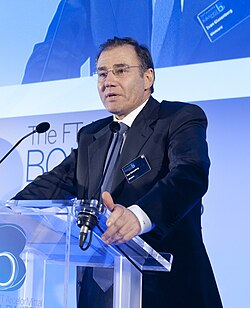
IVAN GLASENBERG
Former CEO of Glencore and architect of the largest London IPO in history
Ivan Glasenberg spent four decades at Glencore when it was still Marc Rich's secretive private trading house — back when commodity traders were considered borderline pirates operating in the shadows of global finance. He took the company public in 2011 in London's largest-ever IPO, raising $10 billion at a $59 billion valuation and making himself and Glencore's trader-partners some of the richest people on earth overnight. He ran it for 20 years on almost no salary, taking dividends instead — perfectly aligning his interests with shareholders. He stepped down in 2021 and left behind a $1.5 billion bribery settlement across three countries. Commodity trading is never fully clean, and Glasenberg never pretended otherwise.
Net Worth
$10B+
Nationality
South African-Swiss
Time Horizon
Long-Term
Risk Appetite
9 / 10
Net Worth Context
- · That's the GDP of a small country — around the size of Greenland.
- · Enough to buy an NBA team and keep $6B for snacks.
CAREER & BACKGROUND
Glasenberg was born in Johannesburg and trained as a chartered accountant. He also competed at the international level in race walking, representing South Africa at the 1980 and 1984 World Race Walking Cup events.
In 1984 he joined Marc Rich and Co — the commodities trading firm founded by the fugitive trader Marc Rich — as a coal trader. He rose through the ranks over two decades, becoming CEO in 2002.
By then the company had been renamed Glencore. He took Glencore public in May 2011 in a £36 billion listing on the London Stock Exchange — the largest IPO in London's history at the time and the fifth largest globally.
He orchestrated Glencore's $29 billion acquisition of Xstrata in 2013, creating one of the world's largest diversified miners and commodity traders with operations spanning coal, copper, zinc, nickel, cobalt, and agricultural commodities. He stepped down as CEO in June 2021, handing the reins to Gary Nagle.
In 2022, Glencore paid $1.5 billion across the US, UK, and Brazil to settle bribery and market manipulation charges relating to conduct that occurred during his tenure.
COMPANIES & ROLES
Glencore (CEO 2002-2021, major shareholder with approximately 9% stake). Marc Rich and Co (predecessor to Glencore, joined 1984).
Glencore's portfolio includes mining assets in Australia, Democratic Republic of Congo, Kazakhstan, South Africa, Colombia, and South America, plus commodity marketing operations spanning 90+ countries.
INVESTING STYLE & PHILOSOPHY
Glasenberg is an operator and commodity trader, not a stock picker. His version of investing is acquiring physical assets — mines, smelters, ports, and logistics networks — and combining them with Glencore's trading infrastructure to control both the commodity and the distribution.
He believes in owning the full supply chain from ground to customer. His deal thesis: buy distressed or unwanted assets in commodity downturns, build them into integrated production and marketing platforms, and monetize them when the cycle turns.
He was famously detail-oriented — reportedly able to walk into any Glencore operation and know the production numbers, cost structure, and margin better than the local managers.
THE PLAYBOOK
Risk Approach
Extremely high — by design. Commodity markets are cyclical, volatile, and unforgiving.
Glasenberg's strategy was to be the lowest-cost producer in every commodity he operated in, so that when prices collapsed, Glencore survived while competitors went bust. He leveraged the balance sheet aggressively during acquisition periods — critics warned Glencore was dangerously indebted after the Xstrata deal — then paid down debt quickly when commodity prices recovered.
He took concentrated positions in complex frontier market mining jurisdictions where others would not go.
Money Habits
Notoriously frugal in personal presentation for a billionaire. Known for flying commercial in coach on some routes.
Did not maintain the billionaire circuit lifestyle. Deeply focused on the business.
After stepping down from Glencore, he has invested in several mining and resources ventures, including a significant stake in the Chevron Lummus Global refining technology business.
BIGGEST WIN
The 2011 Glencore IPO. He converted a private partnership — where traders owned the equity and could not easily sell — into a publicly traded company, creating a liquidity event that made him and dozens of Glencore traders instant billionaires.
At IPO, his personal stake was worth approximately $10 billion. He had managed to take a secretive trading house and turn it into a legitimate global corporation without losing its trading culture or its edge.
BIGGEST MISTAKE
The bribery scandal. Glencore's $1.5 billion settlement in 2022 — covering corrupt payments in Nigeria, Cameroon, Ivory Coast, Equatorial Guinea, Brazil, Venezuela, the US, and other markets — was the culmination of years of doing business the way commodity traders had always done business in frontier markets.
Whether Glasenberg personally approved specific payments is disputed, but they occurred under his leadership for years. The settlement wiped more than $5 billion from Glencore's market value on announcement day.
FINANCIAL PHILOSOPHY
Be the survivor. In cyclical industries, the winners are not those who make the most money at the top of the cycle — they are the ones still standing at the bottom.
Keep your cost of production below the marginal cost of the market, hold enough liquidity to weather three years of bad prices, and use the downturns to acquire assets from those who did not prepare. He famously refused to take a significant salary — his annual CEO pay was roughly $1.35 million — because he believed a CEO whose compensation depends on dividends thinks very differently from one whose pay depends on short-term stock performance.
FAMILY & PERSONAL LIFE
Born January 7, 1957, in Johannesburg, South Africa. Holds South African, Australian, and Israeli citizenship.
He moved to Zug, Switzerland — where Glencore is headquartered — for most of his working career. Married with children.
His son David Glasenberg also works in the commodities and resources sector.
EDUCATION
Graduated from the University of Witwatersrand, Johannesburg with a Bachelor of Accountancy. Qualified as a Chartered Accountant in South Africa.
Completed an MBA at the University of Southern California (USC).
BOOKS & RESOURCES
As an Amazon Associate, Netfigo earns from qualifying purchases. Book links above may be affiliate links.
QUOTES (5)
In commodities, the best time to buy is when nobody wants to. The worst time to buy is when everyone does.
We are not a mining company. We are a trading company that happens to own mines. The difference matters enormously.
I take $1.35 million a year in salary. The rest comes from dividends. That means when shareholders get hurt, I get hurt. That is how it should be.
The balance sheet is not a strategy. It is a constraint. You manage it like a fuel gauge — you never let it hit empty.
I walk the floors of every operation. I know the cost per tonne in every mine. You cannot run a commodity business from a boardroom.
NETFIGO SCORE
Proprietary 5-dimension investor rating
Risk Appetite
Contrarian Index
Track Record
Accessibility
Time Horizon
Related Profiles
Investors
Jim Rogers
Jim Rogers has been one of the most prominent commodity bulls for decades, arguing that the world's physical resource constraints will drive a long commodity supercycle. Glasenberg built the world's largest commodity trader on a similar premise — that physical commodities would remain essential and that controlling their supply chain was the most valuable position to hold.
Paul Tudor Jones
Both represent different branches of the same macro-level commodity thesis — Glasenberg owns the physical supply chain while Tudor Jones has historically traded commodity cycles from the futures markets. Their approaches to commodities and hard assets are complementary but structurally opposite.
Head-to-Head
Compare Ivan Glasenberg vs another investor.