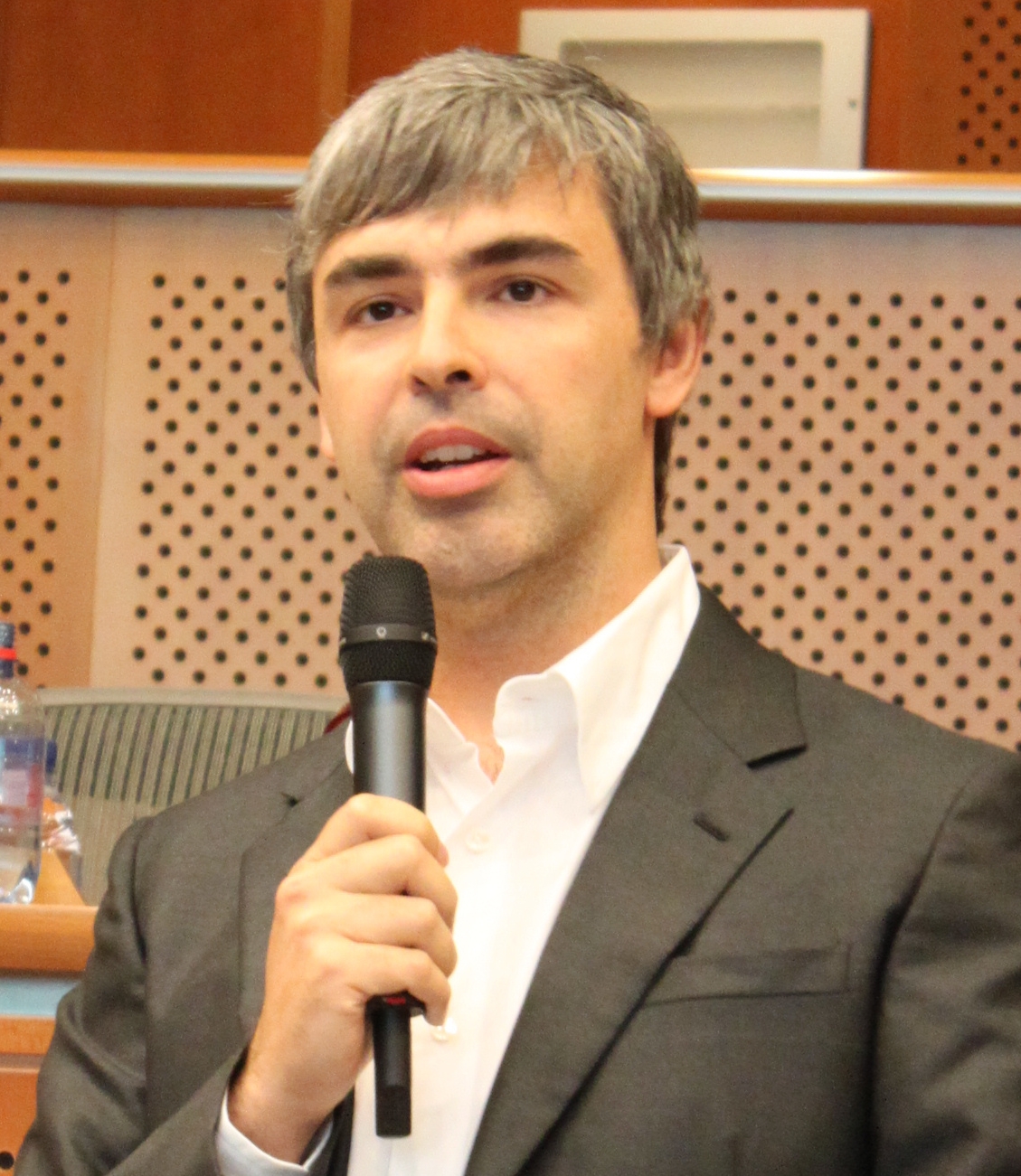
LARRY PAGE
Co-founded Google, built it into a $2 trillion company, and now quietly funds flying car and anti-aging startups
Larry Page co-founded Google with Sergey Brin in a Stanford garage in 1998 and built it into the most dominant technology company of the 21st century. Google's search engine handles 8.5 billion queries per day. YouTube gets 500 hours of video uploaded per minute. Android runs 72% of the world's smartphones. Page is worth $156 billion and has essentially vanished from public life. He has not spoken publicly since 2015. He lives in Fiji and New Zealand. He funds Kitty Hawk (flying cars) and Calico (anti-aging research). He is the $156 billion ghost of Silicon Valley — the most powerful tech founder who simply stopped talking.
Net Worth
$156 billion
Nationality
American
Time Horizon
Generational
Risk Appetite
9 / 10
CAREER & BACKGROUND
Co-founded Google in 1998 with Sergey Brin while both were PhD students at Stanford. Google went public in 2004 at a $23 billion valuation.
Served as CEO of Google from founding until 2001, then again from 2011 to 2015. Created Alphabet (Google's parent company) in 2015 to separate Google's core business from moonshot projects.
Under his leadership, Google acquired YouTube ($1.65B in 2006), Android ($50M in 2005), and DoubleClick ($3.1B in 2007). Alphabet's market cap exceeded $2 trillion.
Page personally holds about 6% of Alphabet shares plus significant other investments. Has invested heavily in Kitty Hawk/Wisk (autonomous flying taxis), Calico (anti-aging biotech), and Planetary Resources (asteroid mining, now defunct).
Has not made a public statement since 2015. Lives part-time in Fiji and New Zealand.
COMPANIES & ROLES
Alphabet/Google (co-founder), Kitty Hawk/Wisk (investor), Calico (backer)
INVESTING STYLE & PHILOSOPHY
Page is a long-term technology visionary who invests in problems that most people think are science fiction. Flying cars.
Anti-aging. Asteroid mining.
His personal investing is concentrated in deep technology moonshots with decade-plus time horizons. He is not interested in incremental improvements — he wants to change the physical world.
Through Alphabet, he pioneered the conglomerate model for tech companies, separating profitable core businesses from speculative "Other Bets."
THE PLAYBOOK
Risk Approach
Extremely high in personal investments. Page has invested hundreds of millions in flying car companies, anti-aging research, and asteroid mining — areas where most investors see pure speculation.
At the corporate level, Google's acquisitions of YouTube and Android were risky bets that paid off spectacularly. His risk tolerance is bounded by the fact that Google prints enough cash to fund virtually any experiment.
Money Habits
Page has essentially disappeared from public life. He lives part-time in Fiji and New Zealand, where he reportedly obtained residency.
He was secretly treated for a vocal cord condition that made public speaking difficult. He does not attend Alphabet shareholder meetings, does not give interviews, and has not made a public statement since 2015.
His philanthropy includes donations to Ebola and flu research through the Carl Victor Page Memorial Foundation.
BIGGEST WIN
Co-founding Google. Building the world's dominant search engine, ad platform, and mobile operating system is arguably the most valuable company creation of the 21st century.
YouTube alone is worth an estimated $400+ billion. Android runs on 3+ billion devices.
Google Search processes 8.5 billion queries per day. The scale is almost incomprehensible.
BIGGEST MISTAKE
Many of Alphabet's "Other Bets" have failed or stagnated. Planetary Resources (asteroid mining) shut down.
Google Glass flopped as a consumer product. Waymo (self-driving cars) has consumed over $5 billion with limited commercial deployment.
The moonshot model produces more misses than hits, though one success could be transformative.
FINANCIAL PHILOSOPHY
Page believes technology should aim to solve the world's biggest problems, not just the most profitable ones. He has spoken about "10x thinking" — trying to make things 10 times better rather than 10% better.
He believes most people and companies are too conservative in their ambitions. He also believes in reducing bureaucracy and giving small teams enormous autonomy.
FAMILY & PERSONAL LIFE
Was married to Lucy Southworth from 2007 to 2024 (reportedly separated). They have two children.
His father, Carl Page, was a computer science professor at Michigan State. His mother, Gloria Page, was a computer programming instructor.
Grew up surrounded by technology.
EDUCATION
Bachelor's degree in Computer Engineering from the University of Michigan. Master's degree in Computer Science from Stanford (did not complete his PhD, though his thesis project — the PageRank algorithm — became the foundation of Google).
BOOKS & RESOURCES
The best account of how Google actually works under Page
The disruption theory that shaped Google X's moonshot approach
Covers the management philosophy Page co-created. The original PageRank paper (co-authored with Sergey Brin at Stanford) is one of the most cited computer science papers ever
As an Amazon Associate, Netfigo earns from qualifying purchases. Book links above may be affiliate links.
QUOTES (6)
If you are not doing some things that are crazy then you are doing the wrong things.
We should be building great things that do not exist. Not just making small improvements to things that already exist.
Lots of companies do not succeed over time. What do they fundamentally do wrong? They usually miss the future.
You do not need to have a 100-person company to develop that idea. It might take five people.
NETFIGO SCORE
Proprietary 5-dimension investor rating
Risk Appetite
Contrarian Index
Track Record
Accessibility
Time Horizon
Related Profiles
Head-to-Head
Compare Larry Page vs another investor.