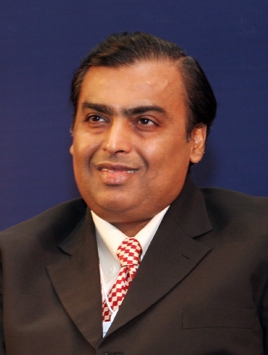
MUKESH AMBANI
Built Reliance Industries into India's most valuable company and rewired how 1.4 billion people access data, energy, and groceries.
Mukesh Ambani inherited half a conglomerate and turned it into the largest company in India's history. Then he launched Jio in 2016 — offering free data and calls to 400 million people — and collapsed the entire Indian telecom industry in about 18 months. His net worth has crossed $100 billion multiple times. He lives in a 27-story private home in Mumbai that cost an estimated $2 billion to build. There is no Western equivalent for what he is. He's part Jeff Bezos, part John D. Rockefeller, and part sovereign nation.
Net Worth
$115 billion
Nationality
Indian
Time Horizon
Generational
Risk Appetite
8 / 10
Net Worth Context
- · Could buy every NFL team simultaneously and still have $-45B left.
- · Earns roughly $10,940 per minute — assuming 5% annual return.
CAREER & BACKGROUND
Mukesh Ambani was born in 1957 in Aden, Yemen, where his father Dhirubhai Ambani had moved to work as a gas station attendant. The family returned to India, and Dhirubhai eventually built Reliance Industries from a textile trading business into one of India's biggest companies — arguably the most remarkable rags-to-riches story in Indian corporate history.
Mukesh joined Reliance in 1981, fresh from Stanford, where he had started an MBA program but left early at his father's request. He was 24.
He immediately threw himself into the operational side of the business, overseeing the construction of a massive polyester yarn plant in Patalganga. It was a $300 million project.
He delivered it in record time. That was the template for how he'd operate for the next four decades — massive bets, aggressive timelines, and an obsession with scale that made Western competitors nervous.
When Dhirubhai died in 2002 without a clear succession plan, it triggered one of the most bitter and public family feuds in Indian business history. Mukesh and his younger brother Anil split the empire in 2005, brokered by their mother Kokilaben.
Mukesh got the crown jewels — refining, petrochemicals, and the telecom license that would later become Jio. Anil got the power, financial services, and entertainment businesses.
In hindsight, Mukesh won the lottery and Anil walked away with a time bomb.
The decade after the split was about consolidation and infrastructure. Mukesh quietly built what would become the world's largest single-location oil refinery at Jamnagar, Gujarat.
The complex can process 1.24 million barrels of oil per day. It's so large it has its own airport, fire station, and township housing tens of thousands of workers.
He was playing a longer game than anyone realized.
Then came Jio. In 2016, Reliance launched Jio Infocomm — a 4G network built from scratch with $32 billion in investment, offering free voice calls and nearly free data.
India went from one of the world's most expensive mobile markets to the cheapest, almost overnight. Data prices fell by 95%.
Competitors like Airtel and Vodafone bled for years. Two major carriers effectively collapsed.
Jio became the world's largest mobile data network by traffic within two years of launch. By 2023, Jio had over 450 million subscribers.
The Jio move wasn't just a telecom play. It was the infrastructure for everything else — JioMart (grocery e-commerce), JioFinance (financial services), JioTV, JioCinema (which streamed the IPL for free in 2023, drawing 32 million concurrent viewers, a world record at the time).
Ambani was building a digital ecosystem to rival Alibaba, Amazon, and Google simultaneously. And he was doing it in a country of 1.4 billion people with rapidly rising incomes.
COMPANIES & ROLES
Reliance Industries is the mothership — a $240 billion conglomerate that is the most valuable company in India. It spans oil refining, petrochemicals, retail, telecom, and increasingly, green energy and media.
When people say Ambani is rich, they mostly mean Reliance.
Jio Platforms is the telecom and digital arm, carved out as a separate entity in 2020 when Ambani raised $20 billion from investors including Facebook (Meta paid $5.7 billion for a 9.99% stake), Google ($4.5 billion for 7.7%), KKR, Silver Lake, Vista Equity, General Atlantic, and others. That fundraise happened during COVID lockdown.
In three months. Which is absurd.
Reliance Retail is the largest retailer in India by revenue — running thousands of stores across grocery, fashion, and electronics. It's fighting Amazon and Flipkart for dominance in Indian e-commerce and, so far, holding its own.
The Jamnagar refinery complex is a physical manifestation of Ambani's infrastructure obsession. The two refineries on the site can process 1.24 million barrels of oil per day, making it the world's largest single-location refinery.
Built from scratch. In Gujarat.
Ahead of schedule.
Reliance New Energy is Ambani's bet on the green future — a $10 billion commitment to build solar, green hydrogen, and battery manufacturing capacity in India. He's targeting net-zero carbon by 2035 for Reliance, which is ambitious given that a significant chunk of the business is still oil.
INVESTING STYLE & PHILOSOPHY
Ambani doesn't think like a stock picker. He thinks like an empire builder.
The question he's always asking isn't 'what's undervalued?' — it's 'what does India need that doesn't exist yet, and can I build it before anyone else?'
The Jio playbook is the clearest example. He looked at Indian telecom in 2011 and saw a market where data was expensive, speeds were terrible, and most people had no reliable internet access.
He spent five years and $32 billion building a 4G network from scratch — no acquisitions, no partnerships, pure greenfield construction. Then he turned it on and gave it away for free.
His logic: if you make something cheap enough and useful enough, you get scale so fast that the economics eventually work out. They did.
This is sometimes described as 'infrastructure-first' investing. You build the pipes, then you figure out what to send through them.
Jio built the pipes. Now everything else — retail, financial services, entertainment, healthcare — runs through those pipes.
He also thinks generationally. The Jamnagar refinery wasn't built in a quarter.
It was a decade-long project. The green energy pivot is another decade-long bet.
He's comfortable with time horizons that would make most investors deeply uncomfortable. When he says Reliance will be a net-zero company by 2035, he means it as a serious infrastructure commitment, not a press release.
Risk management is baked into scale. The theory is simple: if you're big enough and diversified enough, no single failure can kill you.
Reliance has failed at plenty of things — telecom before Jio, retail format experiments, the Hamleys acquisition in the UK that went nowhere. None of it mattered because the core businesses were generating so much cash.
One thing he does NOT do: he doesn't rely on financial engineering. No activist short squeezes, no leveraged buyouts, no complicated derivatives.
His edge is operational — he builds things faster and bigger than anyone else expects, and then uses the scale to drive down costs until competitors can't compete.
THE PLAYBOOK
Risk Approach
Ambani's relationship with risk is counterintuitive. He looks like a high-risk operator — $32 billion on a greenfield telecom network, free data for 400 million people, picking fights with Airtel and Vodafone simultaneously.
But his actual framework is about controlling risk through sheer scale and vertical integration.
The way he explains it is roughly: if you build something big enough that you control the entire supply chain, you eliminate the price risk that kills most businesses. The Jamnagar refinery exists partly for this reason — Reliance processes its own crude, manufactures its own petrochemicals, and sells through its own retail channels.
The margin that would leak to middlemen at every step stays inside the company.
He lost the Anil & Mukesh split badly in one specific area: the gas pricing dispute. In the early 2010s, Ambani had committed to supply gas from the KG-D6 basin to his brother Anil's power company at a fixed price.
Production fell sharply, and the resulting legal dispute with the government over gas pricing tied up billions of dollars for years and nearly derailed the whole basin development. It was a regulatory and operational risk he hadn't fully accounted for.
He's been more careful about government relationship management ever since.
The one risk he consistently accepts is technology obsolescence risk — he's been willing to write off entire business lines when the technology shifts. He didn't try to save 2G and 3G businesses when Jio came along.
He just let Jio cannibalize them. That willingness to obsolete yourself before a competitor does it for you is rare at his scale.
Money Habits
Ambani lives in Antilia, a 27-story private residence in South Mumbai that is widely reported to have cost $1–2 billion to build. It requires a staff of around 600 people to maintain.
It has six underground floors of parking, multiple helipads, a snow room (a room that simulates snowfall, in a tropical city), a 50-seat cinema, multiple swimming pools, and a health club. It is, by most accounts, the most expensive private home ever built.
His wife Nita has said it was designed to be a home, not a statement — which is a very specific way to describe a 27-story building in the middle of Mumbai.
He travels by private jet and keeps a small fleet of luxury vehicles. His personal security detail is one of the largest in India, reportedly numbering in the hundreds.
His wife Nita Ambani is a prominent philanthropist and the founder of the Dhirubhai Ambani International School in Mumbai — which charges some of the highest school fees in India. She's also on the board of Reliance Foundation and in 2023 became the first Indian woman elected to the International Olympic Committee.
Ambani himself is reportedly a creature of strict routine — early mornings, vegetarian diet (he's a devout Hindu), and a workday that his colleagues describe as relentless. He doesn't drink alcohol.
He's not known for flashy social scenes or Hollywood-style celebrity friendships.
His children's weddings have been a different story entirely. His daughter Isha's wedding in 2018 and his son Anant's wedding in 2024 were multi-day events attended by heads of state, global celebrities, and enough flowers to probably constitute a botanical emergency.
Anant's 2024 pre-wedding events alone reportedly cost over $100 million. When you're worth $115 billion, apparently that's the rounding error.
BIGGEST WIN
Jio is the win. In dollar terms, Jio Platforms alone was valued at roughly $65 billion when it completed its 2020 fundraising round — meaning the company Ambani built from scratch on a $32 billion investment was worth double the investment within four years, while simultaneously becoming the dominant digital infrastructure in a country of 1.4 billion people.
But the numbers undersell what actually happened. When Jio launched in September 2016, India had about 200 million internet users, mostly on painfully slow connections.
Data cost around 250 rupees per gigabyte. Within 18 months of Jio's free launch, India had more than 400 million internet users.
Data prices had fallen to around 7 rupees per gigabyte — a 97% collapse. India became the country with the cheapest mobile data in the world.
Two of the top three incumbents — Vodafone India and Idea Cellular — were forced to merge just to survive, and that merged entity (Vi) is still hemorrhaging money years later. Airtel survived but was forced to write off billions and restructure completely.
The 2020 fundraising was its own kind of extraordinary. During a global pandemic lockdown, Ambani raised $20 billion from Facebook, Google, KKR, Silver Lake, and others in about three months.
Facebook's $5.7 billion stake was the largest single FDI into India ever at that point. He used part of the proceeds to make Reliance debt-free — he'd promised to achieve that by March 2021, and he did it in September 2020, six months early.
He announced it at the AGM. The crowd erupted.
BIGGEST MISTAKE
The KG-D6 gas basin. Reliance discovered a massive natural gas field off India's east coast in 2002, and it was supposed to be a transformational find — one of the world's largest gas discoveries, with estimates suggesting it could produce 80 million cubic meters of gas per day.
It didn't. Production peaked at about 60 million cubic meters in 2010 and then fell off a cliff due to geological complexities that Reliance's own engineers apparently hadn't fully modeled.
By 2012, production was down to around 14 million cubic meters. The Indian government accused Reliance of deliberately underproducing to get higher prices.
Reliance denied it. There were years of litigation.
The financial cost is hard to pin down precisely, but Reliance had invested over $9 billion in the basin, and the asset essentially failed to deliver. The downstream consequences were significant too — power plants and fertilizer companies that had contracted for KG-D6 gas were left scrambling, and the credibility hit to Reliance in India's energy sector was real.
The gas pricing dispute with brother Anil's company (ADAG) that ran in parallel cost both brothers time, money, and reputational capital for years. The Supreme Court of India eventually ruled in Mukesh's favor, but by then the damage was done.
The lesson Ambani apparently took from it: subsurface assets are fundamentally uncertain in ways that surface infrastructure is not. His subsequent mega-bets — Jio's towers, the green energy gigafactories — are all physical infrastructure you can see and verify.
No more betting billions on what might be underground.
FINANCIAL PHILOSOPHY
Ambani doesn't publish annual letters or give many long-form interviews about his philosophy. But you can piece it together from what he's built.
Rule one: size is a strategy, not just an outcome. He genuinely believes that scale creates competitive advantages that small players can never replicate — lower input costs, better supplier terms, the ability to absorb losses in one segment while another segment funds it.
He's never tried to build a nimble startup. He builds infrastructure.
Rule two: own the customer relationship end-to-end. This is why Jio wasn't just a SIM card business.
It was always supposed to be the on-ramp to everything else — retail, payments, streaming, health. If Jio is how someone connects to the internet, Reliance has a relationship with that person that no other Indian company can touch.
Rule three: patience is a competitive weapon. Most competitors are constrained by quarterly earnings, investor pressure, or capital access.
Ambani has consistently been willing to operate at a loss for years to build something that matters. Jio ran at a loss for multiple years before becoming the most profitable part of Reliance.
He can do that because the refining business generates enormous cash flows regardless of what the digital businesses are doing.
Rule four: don't fear the government — work with it. India's regulatory environment is complex.
Ambani has navigated it by making Reliance strategically important to the Indian government's own goals — digital inclusion, energy security, manufacturing capacity. That alignment is intentional.
Some critics call it cronyism. He'd probably call it political intelligence.
Rule five: the asset is the business, not the stock. He has never been particularly concerned with Reliance's share price on a quarter-to-quarter basis.
The focus is always on the underlying business — capex cycles, subscriber growth, refinery throughput. The stock eventually catches up.
FAMILY & PERSONAL LIFE
Mukesh married Nita Dalal in 1985. It was an arranged introduction — Dhirubhai reportedly saw Nita dancing at a function and arranged for Mukesh to meet her.
They have three children: Isha, Akash, and Anant. All three are now involved in the Reliance business in senior roles, which is very much by design.
Isha Ambani (born 1991) heads Reliance Retail and Jio Platforms' consumer strategy. She studied psychology at Yale and did an MBA at Stanford, which is a trajectory that makes more sense when you realize her father left his own Stanford MBA to come home and build a business empire.
She married Anand Piramal in 2018 in a wedding that Beyoncé performed at.
Akash Ambani (born 1991 — Isha's twin) chairs Jio Platforms and oversees the telecom business. He married Shloka Mehta in 2019.
He's widely seen as the heir apparent to the broader Reliance empire.
Anant Ambani (born 1995) has been involved in the green energy and retail verticals. His wedding in 2024 to Radhika Merchant was a global media event — pre-wedding festivities included performances by Rihanna and Justin Bieber, and guests included Bill Gates, Mark Zuckerberg, and multiple heads of state.
Mukesh's mother Kokilaben, who brokered the 2005 split between Mukesh and Anil, remained a respected matriarch of the family. His brother Anil's businesses have had a dramatically harder time — Anil Ambani declared personal bankruptcy in a UK court in 2020, an extraordinary fall from the position of the sixth-richest man in the world he held in 2008.
EDUCATION
Ambani did his undergraduate degree in Chemical Engineering at the Institute of Chemical Technology in Mumbai — then known as UDCT. He enrolled in an MBA program at Stanford Business School in 1980 but left after a year when his father called him back to help run Reliance.
He has said he has no regrets about leaving. Given what happened next, that seems like a reasonable position.
BOOKS & RESOURCES
Ambani hasnt written a book, and he gives relatively few long-form interviews compared to his Western counterparts
The most useful primary sources are his annual general meeting speeches — available on Reliance's investor relations website — which are unusually candid about strategy and vision for a CEO of a company that size
An unauthorized biography of Dhirubhai Ambani that provides the essential backstory to everything Mukesh built
Covers the succession battle and the split, and is probably the best single account of how Mukesh emerged from his father's shadow
For the Jio story specifically, the annual reports from 2016–2020 read like a business school case study in real time
The 2020 AGM speech, where Ambani announced Reliance was debt-free, is worth reading in full — it's one of the best CEO communications of the last decade
's 'India Unbound' is essential reading — it traces Indian economic history from independence through liberalization and explains why the 1991 reforms created the conditions for Reliance's second act
As an Amazon Associate, Netfigo earns from qualifying purchases. Book links above may be affiliate links.
QUOTES (6)
Our dreams have to be bigger. Our ambitions higher. Our commitment deeper. And our efforts greater.
Jio is India's gift to the world. We are committed to connecting everyone.
I believe we are at the beginning of a new era — the era of the fourth industrial revolution, driven by digital technology.
Data is the new oil, and India is now the world's leading data-consuming nation.
My father always said: if you are born poor, it's not your fault. But if you die poor, it is your fault.
Think big, think fast, think ahead. Ideas are no one's monopoly.
NETFIGO SCORE
Proprietary 5-dimension investor rating
Risk Appetite
Contrarian Index
Track Record
Accessibility
Time Horizon
Related Profiles
Investors
Li Ka-Shing
Asia's two great conglomerate builders — both turned manufacturing-era wealth into digital-era dominance through vertical integration and infrastructure scale
Masayoshi Son
Both built technology-first infrastructure empires across Asia through massive capital deployment and long-term bets on digital ecosystems
Head-to-Head
Compare Mukesh Ambani vs another investor.