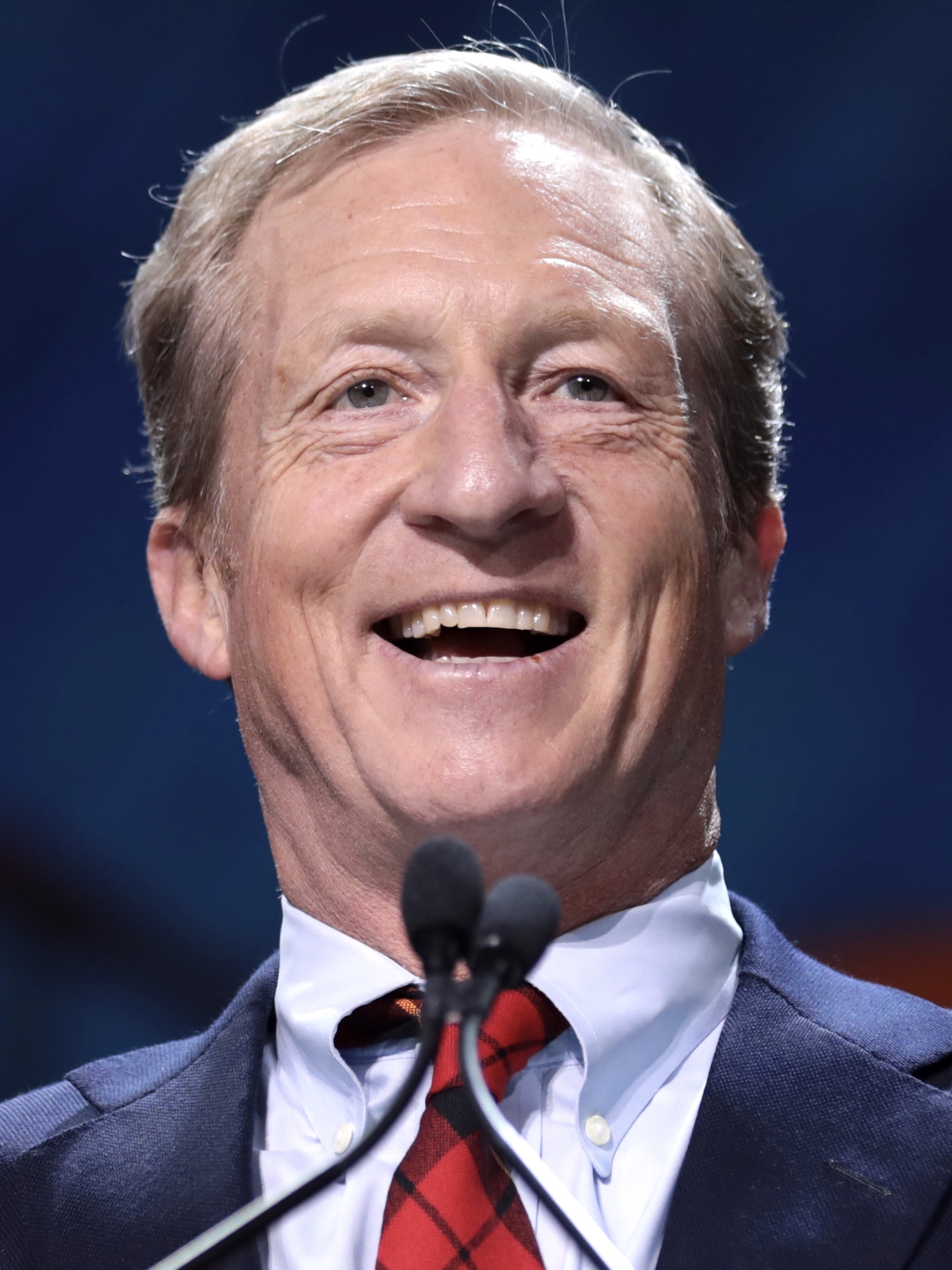
TOM STEYER
Hedge fund billionaire turned climate activist and 2020 presidential candidate who spent $340 million of his own money on politics
Tom Steyer made $1.6 billion running Farallon Capital, one of the most successful hedge funds of the 1990s and 2000s. Then he quit finance, became a climate activist, and spent $340 million running for president — finishing with about 0.1% of delegates. He’s proof that being great at making money doesn’t mean you’re great at spending it on political campaigns. The most expensive hobby in American history.
Net Worth
$1.6 billion
Nationality
American
Time Horizon
Long-Term
Risk Appetite
5 / 10
Net Worth Context
- · Still a billionaire — just the quiet kind at the end of the table.
CAREER & BACKGROUND
Steyer grew up in New York, son of a corporate lawyer. He went to Yale, then Stanford Business School, then joined Morgan Stanley and Goldman Sachs.
In 1986, he founded Farallon Capital Management in San Francisco.
Farallon became one of the best-performing hedge funds in the world. It specialized in event-driven and value investing across stocks, bonds, real estate, and private equity.
At its peak, the fund managed over $20 billion. Steyer personally made billions in management and performance fees.
In 2012, he stepped down from Farallon to focus full-time on politics and climate activism. He founded NextGen America, a political advocacy group focused on climate change.
He spent over $70 million on the 2014 midterm elections alone. Then in 2019, he announced he was running for president.
He spent approximately $340 million on his campaign and dropped out after the South Carolina primary in February 2020. He won zero states.
Since then, he’s focused on climate investing through Galvanize Climate Solutions, a firm that invests in companies addressing climate change.
COMPANIES & ROLES
Farallon Capital Management was his hedge fund empire. Founded in 1986 with a few million dollars, it grew to over $20 billion in assets.
The fund invested across everything — stocks, bonds, real estate, distressed debt, private equity. It was one of the most consistently profitable multi-strategy funds in the industry.
NextGen America is his political advocacy organization, focused primarily on climate change and voter turnout among young people. He’s pumped hundreds of millions into it.
Galvanize Climate Solutions is his current venture — a climate-focused investment firm that backs companies working on decarbonization, clean energy, and sustainable infrastructure. He’s essentially trying to use the investing skills that made him rich to address the climate crisis.
INVESTING STYLE & PHILOSOPHY
At Farallon, Steyer was a classic multi-strategy investor. He looked for value across asset classes — if a distressed bond was cheap, he’d buy it.
If a real estate deal had an unusual angle, he’d pursue it. The approach was fundamentally opportunistic — go where the best risk-adjusted returns are.
He was patient and methodical. Farallon wasn’t a swing-for-the-fences fund.
It aimed for consistent mid-teens returns with low volatility. The magic was in the breadth — by investing across so many different areas, the fund could always find opportunities even when one market dried up.
Now at Galvanize, his investing style has a climate filter on top. He’s looking for the same fundamental value but within the lens of decarbonization.
THE PLAYBOOK
Risk Approach
Moderate by hedge fund standards. Farallon was built on the idea of generating steady returns without taking excessive risk.
The fund rarely had years with large drawdowns. Steyer was disciplined about diversification and position sizing.
His political spending, however, shows a different risk appetite entirely. Spending $340 million on a presidential campaign with essentially zero probability of winning is the kind of risk no hedge fund manager would take with client money.
With his own money, apparently the rules are different.
Money Habits
Steyer has signed the Giving Pledge, committing to give away at least half his fortune. He lives in San Francisco in a style that’s comfortable but not ostentatious by billionaire standards.
His spending is overwhelmingly political — he’s donated over $500 million to political causes and campaigns since leaving Farallon.
He drives a Prius. Wears a plaid tie to basically every public appearance.
His personal brand is deliberately not flashy — he wants to be seen as a man of the people, even though he’s worth $1.6 billion. The gap between image and reality is part of the political game.
BIGGEST WIN
Building Farallon Capital from scratch in 1986 to over $20 billion in assets. The fund delivered annualized returns of approximately 15% over two decades with remarkably low volatility.
One of Farallon’s best trades was a massive position in Indonesian assets during the 1998 Asian financial crisis — buying when everyone else was selling and riding the recovery for enormous gains. The fund also made significant profits from real estate investments and distressed debt during multiple market dislocations.
BIGGEST MISTAKE
The 2020 presidential campaign. By any financial measure, spending $340 million to win zero states is a catastrophically bad investment.
Steyer didn’t even make it to Super Tuesday in a meaningful way. His campaign never gained traction because voters simply weren’t interested in another billionaire telling them he understood their problems.
Within his investing career, Farallon faced criticism for some of its investments in coal and fossil fuels — a particular irony given Steyer’s later reinvention as a climate activist. Environmental groups called him a hypocrite.
He eventually divested and pledged to give away his climate-related gains, but the optics were damaging.
FINANCIAL PHILOSOPHY
Steyer believes in finding value where others see chaos. At Farallon, this meant investing in distressed situations, emerging markets in crisis, and complex multi-asset deals.
The principle is simple: when everyone is panicking, the best prices are available.
He also believes, more recently, that climate change is the defining investment opportunity of the next century. He thinks the companies that solve decarbonization will be the Amazons and Googles of the 2030s and 2040s.
Whether he’s right about that is still TBD.
FAMILY & PERSONAL LIFE
Steyer is married to Kathryn Taylor, who he met at Morgan Stanley. They have four children.
The family lives in San Francisco. Taylor has been active in civic affairs and education reform.
The Steyers are one of the most politically active billionaire couples in America — which puts them in a surprisingly competitive field.
EDUCATION
Yale University for undergrad, where he was a member of Skull and Bones. Then Stanford Graduate School of Business for his MBA.
The Yale-to-Stanford pipeline is basically the assembly line for California-based hedge fund founders. He also briefly taught at Stanford’s business school.
BOOKS & RESOURCES
Became his bible when he pivoted to climate investing — it ranks the most impactful solutions to climate change by their potential CO2 reduction
Captures the kind of contrarian, crisis-driven investing that Farallon excelled at
As an Amazon Associate, Netfigo earns from qualifying purchases. Book links above may be affiliate links.
QUOTES (5)
Climate change is the biggest investment opportunity and the biggest threat of our lifetime. You can’t separate the two.
I spent $340 million running for president and I’d do it again. Some things are worth more than money.
The fossil fuel industry is the most powerful industry in the world and it’s destroying the planet. Somebody has to fight them.
At Farallon, I learned that the best investments are in crisis situations where everyone else is running away.
NETFIGO SCORE
Proprietary 5-dimension investor rating
Risk Appetite
Contrarian Index
Track Record
Accessibility
Time Horizon
Related Profiles
Head-to-Head
Compare Tom Steyer vs another investor.