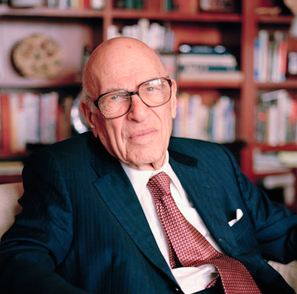
WALTER SCHLOSS
Deep value investor who beat the market for 50 years with zero technology
The man who proved you don't need Bloomberg terminals, Harvard MBAs, or even company visits to beat the market for five decades straight. Schloss worked from a tiny office, used paper financial statements, never used a computer, and compounded at 15.3% annually for 50 years. Buffett called him a "superinvestor." He was the anti-Wall Street — proof that discipline and a Graham textbook can beat every fancy algorithm ever built.
Net Worth
$100 million (at death)
Nationality
American
Time Horizon
Long-Term
Risk Appetite
3 / 10
CAREER & BACKGROUND
Born in 1916 in New York City. Never went to college.
Instead, he took Benjamin Graham's investment course at the New York Stock Exchange Institute — the same course that shaped Buffett. Then he worked for Graham at Graham-Newman Corporation alongside Warren Buffett.
Started his own partnership, Walter J. Schloss Associates, in 1955.
He ran it for 47 years until closing it in 2002. During that time, he compounded at 15.3% annually gross (versus 11.5% for the S&P 500).
Before fees but even after fees, his investors crushed the market.
Buffett featured him in his famous 1984 speech "The Superinvestors of Graham-and-Doddsville" as proof that value investing works. Schloss was Superinvestor #1 on the list.
COMPANIES & ROLES
Walter J. Schloss Associates was his one and only business.
He ran it from a single room — literally one room — in the offices of Tweedy, Browne & Company. No analysts.
No Bloomberg. No company visits.
Just him, his son Edwin (who joined later), and stacks of Value Line tear sheets.
At its peak the partnership managed around $130 million. Small by Wall Street standards but enormous for a two-person operation using Depression-era methods.
He never branched into other businesses, advisory work, or media. He just picked stocks from a tiny office for half a century.
INVESTING STYLE & PHILOSOPHY
Pure deep value in the Benjamin Graham tradition. Schloss bought stocks trading below their book value — preferably below net current asset value.
He didn't talk to management. He didn't visit factories.
He didn't model future earnings. He just looked at the balance sheet.
He typically owned 100+ stocks at a time — extreme diversification by value investing standards. If a stock was statistically cheap, he bought it.
No story, no thesis, no catalyst. Just cheapness.
He was patient beyond belief. He'd hold stocks for years waiting for the market to recognize the value.
He said the stock market was a patient man's game and an impatient man's enemy.
THE PLAYBOOK
Risk Approach
Low in every individual position, moderate in aggregate. Schloss spread his bets across 100+ stocks, so no single failure could hurt him.
But he was buying unloved, beaten-down companies — the kind that can go to zero.
His risk management was diversification and a strict focus on balance sheet value. If you buy a company below its liquidation value, your downside is limited even if the business deteriorates.
Money Habits
Famously frugal. Schloss took the subway to work every day.
He ate lunch at his desk. He wore the same modest suits.
He and his wife lived in a rent-controlled apartment on the Upper East Side of Manhattan for decades.
He didn't seek wealth for lifestyle — he sought it as a scorecard for good investing. He donated generously but quietly to medical and educational causes.
BIGGEST WIN
Compound returns over 50 years. His 15.3% annual return doesn't sound flashy, but over 50 years it turns $10,000 into $11.2 million.
The S&P 500 at 11.5% would have turned it into $2.1 million. His consistency — beating the market in most decades for half a century — is the real achievement.
It's one of the longest market-beating track records in history.
BIGGEST MISTAKE
Schloss didn't have spectacular failures because his extreme diversification prevented any single position from mattering too much. His approach meant he owned plenty of stocks that went nowhere or declined, but the winners always more than compensated.
His biggest "mistake" was his humility — he could have managed billions and earned enormous fees, but he kept his fund small and his fees modest.
FINANCIAL PHILOSOPHY
Schloss followed Benjamin Graham's principles with monastic devotion for 50 years. Buy below book value.
Diversify. Be patient.
Don't pay attention to Wall Street opinions. Don't try to predict the economy.
He published "Factors Needed to Make Money in the Stock Market" — a one-page summary of 16 investing rules. It includes gems like "Don't be in too much of a hurry to sell" and "Buy companies with no or low debt."
His deepest belief: the market always overreacts. Stocks get too cheap and too expensive.
Buying the cheap ones and waiting is all you need.
FAMILY & PERSONAL LIFE
Married to Anna Schloss. They had two children.
His son Edwin joined the partnership and worked alongside him for decades. Walter Schloss died in 2012 at age 95, still sharp and still interested in stocks.
EDUCATION
Never attended college. Took Benjamin Graham's evening course at the New York Stock Exchange Institute in the 1930s.
Then worked for Graham directly at Graham-Newman Corporation. His education was entirely self-made and practical.
He proved that formal credentials are irrelevant to investment success.
BOOKS & RESOURCES
The value investing bible Schloss studied under Graham himself at Columbia
Schloss practiced Graham's framework more faithfully than almost anyone. His one-page "Factors Needed to Make Money in the Stock Market" is freely available online and is one of the most concise investment guides ever written
As an Amazon Associate, Netfigo earns from qualifying purchases. Book links above may be affiliate links.
QUOTES (6)
Try to buy assets at a discount rather than buying earnings. Earnings can change dramatically in a short time.
I like buying companies that have low debt. I don't like businesses that owe a lot of money.
Remember the power of compounding. You don't need to make spectacular returns to build real wealth.
If a stock is cheap enough, I don't need to know the story. The balance sheet tells me everything I need.
NETFIGO SCORE
Proprietary 5-dimension investor rating
Risk Appetite
Contrarian Index
Track Record
Accessibility
Time Horizon
Related Profiles
Head-to-Head
Compare Walter Schloss vs another investor.