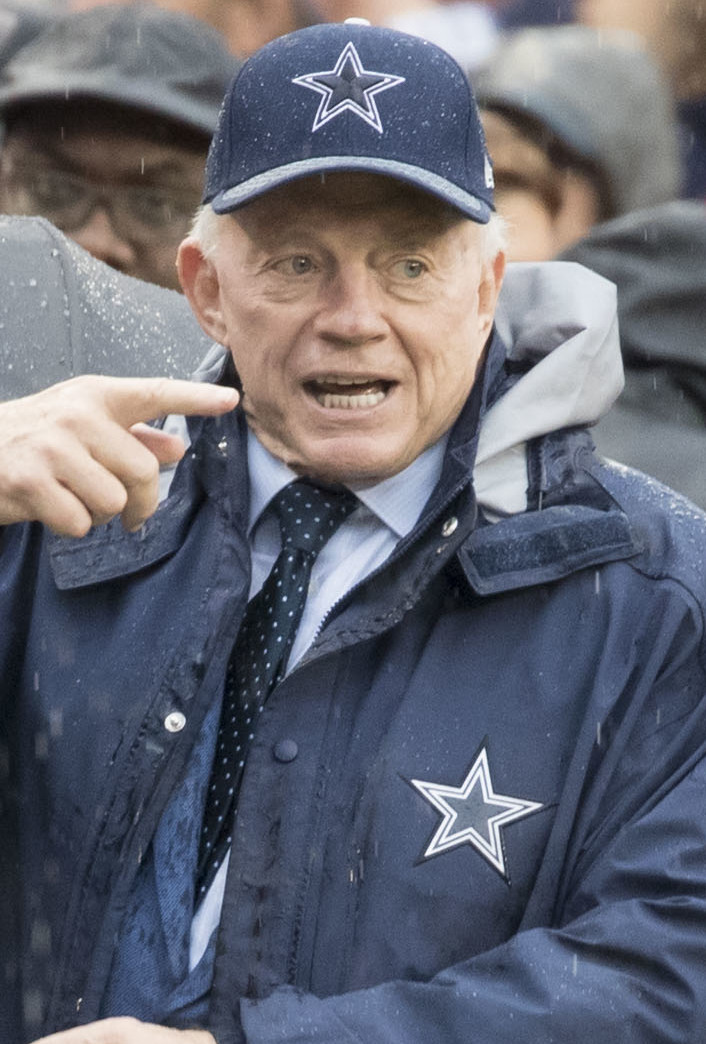
JERRY JONES
Owner of the Dallas Cowboys since 1989. Turned a $150 million purchase into the most valuable sports franchise on earth at $9 billion.
Jerry Jones bought the Dallas Cowboys in 1989 for $150 million when the franchise was losing $1 million a month. Today the Cowboys are worth $9 billion — the most valuable sports franchise on the planet. They haven't won a Super Bowl since 1996. Jones doesn't care. He's the GM, the owner, the marketing genius, and the guy who proved you don't need championships to print money. The stadium cost $1.2 billion and has a TV screen bigger than most people's apartments.
Net Worth
$14.6 Billion
Nationality
American
Time Horizon
Long-Term
Risk Appetite
8 / 10
Net Worth Context
- · That's the GDP of a small country — around the size of Greenland.
- · Enough to buy an NBA team and keep $11B for snacks.
CAREER & BACKGROUND
Jerral Wayne Jones was born in Los Angeles in 1942 and grew up in North Little Rock, Arkansas. His father, Pat Jones, ran a grocery store chain and later made a fortune in insurance.
Jerry played offensive lineman at the University of Arkansas, where he was teammates with future NFL coach Jimmy Johnson. They won the 1964 national championship together.
After college, Jones tried to buy the San Diego Chargers in the 1960s but couldn't pull it together. He went into the oil and gas business instead, founding Jones Oil and Land Lease.
He nearly went bankrupt in the early 1970s when several exploration wells came up dry. Then he hit big in Oklahoma and Arkansas natural gas fields and built a real fortune.
In February 1989, he bought the Dallas Cowboys from H.R. "Bum" Bright for $150 million — at the time the most ever paid for a sports franchise.
The team was hemorrhaging money and had gone 3-13 the previous season. His first move was firing legendary coach Tom Landry, which made him the most hated man in Texas for about six months.
COMPANIES & ROLES
The Dallas Cowboys are the main event. Jones bought them for $150 million in 1989.
Today they're worth roughly $9 billion. He also owns Comstock Resources, a natural gas exploration and production company that went public in 1988 and has been a significant part of his non-football wealth.
Jones Oil and Land Lease was his original energy company. He built and owns AT&T Stadium in Arlington, Texas — a $1.2 billion palace with the famous 160-foot-wide video board.
He also has real estate, pipeline, and energy holdings across Arkansas, Oklahoma, and Texas.
INVESTING STYLE & PHILOSOPHY
Jones is an operator-investor. He doesn't buy things and sit back.
He buys things and takes over every single function. With the Cowboys, he fired the GM and made himself GM.
He fired the marketing department and sold sponsorships himself. He pioneered individual team marketing deals in the NFL — breaking the league's collective revenue model — and cut his own deals with Pepsi, Nike, and American Express.
In energy, he was a wildcatter: drill a lot of holes, accept that most will be dry, and make sure the ones that hit pay for everything else ten times over. His investment philosophy is essentially: control everything, outwork everyone, and never let someone else make the big decisions.
THE PLAYBOOK
Risk Approach
Jones is comfortable with enormous risk. He nearly went bankrupt in the oil business before hitting it big.
He bet $150 million on a losing football team. He spent $1.2 billion on a stadium when people said it was insane.
He has consistently made the biggest possible bet and then worked obsessively to make it pay off. But he also hedges in his own way — his energy business provides a cash flow cushion independent of the Cowboys, and he has diversified real estate holdings.
His risk tolerance is sky-high on things he controls directly and much lower on passive investments where he can't influence the outcome.
Money Habits
Jones lives large. He has a $250 million yacht called "Bravo Eugenia" — 357 feet long, one of the biggest private yachts in the world.
He flies private. He has homes in Dallas, Arkansas, and Cabo San Lucas.
He wears custom suits, always looks camera-ready, and has never met a luxury he didn't enjoy. But he's also genuinely generous — he has donated heavily to the University of Arkansas, the Salvation Army (the Cowboys' annual Thanksgiving halftime show is a Salvation Army fundraiser), and various Dallas-area charities.
He works constantly. He's in his 80s and still acts as the Cowboys' general manager, doing the draft prep, negotiating contracts, and making roster decisions.
BIGGEST WIN
Buying the Dallas Cowboys for $150 million in 1989. The franchise was worth about $200 million at the time and losing money every month.
Jones hired Jimmy Johnson, rebuilt the roster, and won three Super Bowls in four years (1992, 1993, 1995). But the real win isn't the trophies — it's the business.
The Cowboys generate over $1 billion in annual revenue. AT&T Stadium hosts Super Bowls, concerts, and college games.
The franchise is now worth $9 billion. That's a 60x return on his original investment.
BIGGEST MISTAKE
Firing Jimmy Johnson after the second consecutive Super Bowl in 1994. Johnson had built the dynasty from scratch, and Jones wanted more credit.
Their egos collided, and Jones let Johnson walk. He replaced him with Barry Switzer, who won one more Super Bowl on Johnson's roster and then the team declined.
The Cowboys haven't won a Super Bowl since 1996 — nearly 30 years. Jones has been his own GM ever since, and the team's on-field performance since the late 1990s is the direct result.
He's arguably the best owner in football and the worst general manager at the same time.
FINANCIAL PHILOSOPHY
Jones believes in total control. He thinks the person who owns the asset should run the asset.
He doesn't believe in delegating the big decisions. He also believes in marketing over everything — the Cowboys make more money than any franchise in sports despite not winning a championship in decades, because Jones understood before anyone else that sports is entertainment first and competition second.
"The hole in my pocket is just as important as the hole in my arm" — meaning the experience of spending money at the stadium matters as much as what happens on the field.
FAMILY & PERSONAL LIFE
Jones married Eugenia "Gene" Jones in 1963. They have three children: Stephen (who runs day-to-day Cowboys operations as EVP), Charlotte (who oversees brand management), and Jerry Jr.
(who handles sales and marketing). It's very much a family operation.
Gene Jones has her own significant philanthropic profile in Dallas. Jerry is known for being extremely sociable — he'll talk to anyone, anywhere, for as long as they'll listen.
He's also known for occasional late-night quotes to reporters that generate headlines.
EDUCATION
University of Arkansas, where he played on the 1964 national championship football team under coach Frank Broyles. He earned a degree in business.
His time at Arkansas is where he met Jimmy Johnson and formed the relationship that would eventually lead to the Cowboys dynasty — and then its most famous breakup.
BOOKS & RESOURCES
Jones hasnt written books himself, but several books cover his story well.
Covers the business of the NFL and Jones's role in transforming it
Tells the story of the Cowboys purchase and the dynasty years
The Last Cowboy by Mark Ribowsky goes deeper on the Jones
Johnson feud and its aftermath
As an Amazon Associate, Netfigo earns from qualifying purchases. Book links above may be affiliate links.
QUOTES (5)
I don't believe in a general manager system. I want to make the final decisions.
I'm not going to sit up here and say that money doesn't matter. It matters to me.
We live in a world of instant replay. You've got to perform every day.
NETFIGO SCORE
Proprietary 5-dimension investor rating
Risk Appetite
Contrarian Index
Track Record
Accessibility
Time Horizon
Related Profiles
Head-to-Head
Compare Jerry Jones vs another investor.