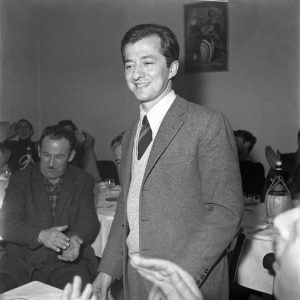
LEONARDO DEL VECCHIO
Founded Luxottica, which makes the glasses on nearly every face in the developed world. Ray-Ban, Oakley, Persol, Oliver Peoples — all his.
Leonardo Del Vecchio grew up in a Milanese orphanage, apprenticed as a metalworker at 14, and built Luxottica into a company that controls roughly 80% of the premium eyewear market. Ray-Ban, Oakley, Persol, Oliver Peoples, LensCrafters, Sunglass Hut — all him. When he merged Luxottica with Essilor in 2018, he created a $70 billion company that makes both the lenses and the frames. He died in 2022 at 87, leaving behind the closest thing to a monopoly that fashion has ever seen.
Net Worth
$27 billion (at death)
Nationality
Italian
Time Horizon
Generational
Risk Appetite
7 / 10
CAREER & BACKGROUND
Del Vecchio was born in 1935 in Milan. His father, a street vendor, died before Leonardo was born.
His mother, unable to support all her children, placed him in an orphanage. He lived there until age 14, when he became an apprentice at a metalworking shop that made molds for auto parts and small metal components.
At 23, he moved to Agordo, a small town in the Dolomite mountains, and started making eyeglass parts. In 1961, he founded Luxottica.
For the first decade, the company just made components. Frames, hinges, temples.
Then Del Vecchio had the insight that changed everything: why sell parts to brands when you can be the brand?
In the 1980s and 1990s, he went on an acquisition spree. He bought the license to make glasses for Giorgio Armani, then Chanel, then Prada, then Versace, then Bulgari.
He bought Ray-Ban from Bausch & Lomb in 1999 for $640 million. He bought Oakley in 2007 for $2.1 billion after a hostile takeover.
On the retail side, he bought LensCrafters, Sunglass Hut, Pearle Vision, and Target Optical. He controlled both the manufacturing and the retail distribution.
If you bought premium glasses anywhere in the Western world, the money almost certainly went to Del Vecchio.
In 2018, he merged Luxottica with French lens maker Essilor to create EssilorLuxottica, a $70 billion behemoth that controls both sides of the eyewear business. He became the largest shareholder and executive chairman.
COMPANIES & ROLES
EssilorLuxottica is the empire. A $70 billion company that makes Ray-Ban, Oakley, Persol, Oliver Peoples, and licensed frames for Chanel, Prada, Versace, Tiffany, Ralph Lauren, Armani, and dozens more.
On the lens side, Essilor makes Varilux, Crizal, and Transitions lenses. The combined company employs over 190,000 people.
On the retail side: LensCrafters (1,000+ stores), Sunglass Hut (3,000+ stores), Pearle Vision, Target Optical, and GrandVision. Plus the online platform, Glasses.com.
Outside eyewear, Del Vecchio owned a significant stake in Mediobanca, Italy's most powerful investment bank. He also held stakes in Generali, Italy's largest insurer, and Covivio, a European real estate company.
INVESTING STYLE & PHILOSOPHY
Vertical integration taken to its logical extreme. Del Vecchio didn't just want to make glasses.
He wanted to design them, manufacture them, brand them, distribute them, and sell them directly to consumers. Cut out every middleman.
Control every link in the chain.
He thought like a monopolist. If you control the brands, the manufacturing, and the retail stores, nobody can compete with you on price, quality, or distribution.
The only thing left for competitors is the bottom of the market, which has thin margins anyway.
The Essilor merger was the final piece. Now the company that makes the frames also makes the lenses.
From raw materials to your face, every step generates a margin for the same company.
THE PLAYBOOK
Risk Approach
Moderate to aggressive. Del Vecchio made big, concentrated bets.
The Ray-Ban acquisition was a bet on reviving a fading brand. The Oakley hostile takeover was combative and expensive.
The Essilor merger was a $50 billion deal that took years to negotiate.
But each bet was in his area of expertise. He never strayed far from eyewear.
He understood the industry better than anyone alive and used that knowledge to take risks that looked wild from the outside but were calculated from the inside.
Money Habits
Despite being Italy's richest man, Del Vecchio was not flashy by Italian billionaire standards. He lived in Milan, not Monaco.
He didn't own a football club. He didn't buy newspapers for political influence.
He wore Luxottica glasses, obviously. Reportedly changed his frames frequently to test new designs himself.
He visited factories regularly well into his 80s, checking production quality in person.
His personal life was more complicated. He was married three times and had six children from four different women.
The succession planning for EssilorLuxottica became a significant concern in his final years, given the size of the estate and the number of heirs.
He gave relatively little to charity compared to his net worth, preferring to invest in expanding the business rather than philanthropy.
BIGGEST WIN
Buying Ray-Ban in 1999 for $640 million and turning it into one of the most valuable eyewear brands in the world. When Luxottica bought Ray-Ban from Bausch & Lomb, the brand was declining.
Sales were flat, the design felt dated, and discount retailers were undermining its premium positioning.
Del Vecchio pulled Ray-Ban from discount stores, raised prices, invested in marketing, and turned it into a lifestyle brand. Aviators became cool again.
Wayfarers became ubiquitous. Within a decade, Ray-Ban went from a dusty heritage brand to the most recognizable sunglasses on Earth.
Today Ray-Ban generates billions in annual revenue and is worth many multiples of what Del Vecchio paid. The $640 million purchase might be the best deal in fashion history.
BIGGEST MISTAKE
The Oakley hostile takeover in 2007. Oakley's CEO Jim Jannard publicly accused Luxottica of using its retail monopoly to squeeze Oakley's margins.
The relationship turned hostile. Del Vecchio eventually bought Oakley for $2.1 billion, but the process was ugly and expensive.
The saga also drew attention to Luxottica's market dominance. A 60 Minutes expose in 2012 detailed how one company controlled so much of the eyewear market, raising questions about antitrust that dog the company to this day.
Del Vecchio also arguably paid too much for GrandVision, the European optical retail chain, in 2019. The $8 billion deal was plagued by regulatory delays and integration challenges.
FINANCIAL PHILOSOPHY
Control is everything. Del Vecchio believed that owning the entire value chain was the only way to protect margins and quality.
He once said that a brand without distribution is just a logo, and distribution without brands is just a shelf.
He also believed in physical manufacturing. While many luxury companies outsourced production to cut costs, Del Vecchio kept Luxottica's factories in Italy.
The quality was better, and it gave him a selling point with luxury brands who wanted "Made in Italy" on their frames.
Patience was non-negotiable. He spent decades building Luxottica before the big acquisitions.
By the time he bought Ray-Ban, he had 38 years of experience in eyewear. He knew exactly what he was buying and exactly what he could do with it.
FAMILY & PERSONAL LIFE
Del Vecchio's personal life was as complex as his corporate empire. He was married three times and had six children: Claudio, Marisa, and Paola from his first marriage, Leonardo Maria from his second, and Luca and Clemente from his third wife Nicoletta Zampillo, whom he divorced, then remarried.
The succession question became a national story in Italy. Six heirs, a $27 billion fortune, and the largest eyewear company in the world.
Del Vecchio set up a family holding company, Delfin, to manage the stake. His will reportedly divided shares equally among the six children and his third wife.
The orphanage boy who built an empire left behind the kind of family drama that Italian novelists dream about.
EDUCATION
Del Vecchio never finished formal schooling. He left the orphanage at 14 to work as an apprentice metalworker.
His education was entirely on the factory floor.
This shaped his management style. He valued craftsmanship and technical knowledge over business degrees.
Luxottica's headquarters felt more like a workshop than a corporate office. Engineers and designers had more status than MBAs.
BOOKS & RESOURCES
Del Vecchio never wrote a memoir, though many have been written about him
He was notoriously press-shy and gave few interviews in his lifetime
Covers Luxottica's rise and the eyewear industry's transformation
Glasses and Sunglasses by Franca Acerenza puts the Luxottica story in the broader context of eyewear as both a medical device and a fashion accessory.
As an Amazon Associate, Netfigo earns from qualifying purchases. Book links above may be affiliate links.
QUOTES (5)
A brand without distribution is just a logo. Distribution without brands is just a shelf.
Glasses are the only product people wear on their face every day. That is a very powerful position.
Italy knows how to make beautiful things. My job was to make sure beautiful things reached every corner of the world.
NETFIGO SCORE
Proprietary 5-dimension investor rating
Risk Appetite
Contrarian Index
Track Record
Accessibility
Time Horizon
Related Profiles
Head-to-Head
Compare Leonardo Del Vecchio vs another investor.