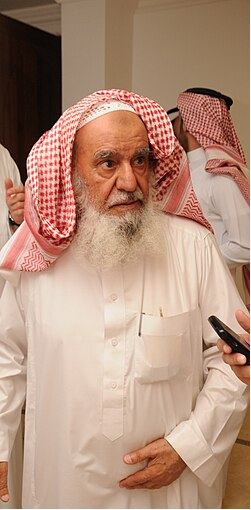
SULAIMAN AL RAJHI
Co-founding Al Rajhi Bank — the world's largest Islamic bank — from humble money-changing roots in rural Saudi Arabia.
Sulaiman Al Rajhi started as a money changer at age 12 in the 1930s in Qassim, one of the poorest provinces in Saudi Arabia. He and his brothers turned that into Al Rajhi Bank — the largest Islamic bank on earth, with assets over $250 billion. He reportedly donated more than $1 billion to Islamic charitable causes during his lifetime. He died in 2011 at around 91 years old. From a child with a currency exchange table to the patriarch of a global banking empire — that is a generational arc that almost nobody achieves.
Net Worth
~$7 billion (at time of death)
Nationality
Saudi Arabian
Time Horizon
Generational
Risk Appetite
3 / 10
Net Worth Context
- · Still a billionaire — just the quiet kind at the end of the table.
CAREER & BACKGROUND
Sulaiman Al Rajhi was born around 1920 in the Qassim region of central Saudi Arabia, into a modest family with no banking infrastructure and no formal financial system around them. At roughly 12 years old, he began working as a money changer — converting foreign currency for pilgrims traveling to Mecca and Medina.
This was the seed. He and his three brothers — Saleh, Abdullah, and Mohammed — built their currency exchange into one of the most prominent money-changing operations in Saudi Arabia through the 1950s.
In 1957, they formally established what would eventually become Al Rajhi Banking and Investment Corporation. The bank grew alongside Saudi Arabia's oil boom, serving millions of workers sending remittances home and millions of Muslim consumers who needed banking services that complied with Sharia law.
By the time Sulaiman died on February 3, 2011, Al Rajhi Bank had become the world's largest Islamic bank by assets and market capitalization, listed on the Saudi Stock Exchange (Tadawul), with branches across Saudi Arabia and internationally.
COMPANIES & ROLES
Al Rajhi Bank is the primary legacy. Founded in 1957, it operates as a fully Sharia-compliant institution — no interest charged or paid, with all products structured around Islamic finance principles such as murabaha (cost-plus financing) and ijara (lease-based products).
By the 2020s, the bank had over $250 billion in assets, around 600 branches in Saudi Arabia alone, and operations in Malaysia, Kuwait, and Jordan. It is the largest bank in Saudi Arabia by market capitalization and the largest Islamic bank globally.
The Al Rajhi family also has significant agricultural and real estate holdings through Al Rajhi Agricultural Company, one of Saudi Arabia's largest farming operations.
INVESTING STYLE & PHILOSOPHY
Sulaiman Al Rajhi was not a financial markets investor in the conventional sense — he was a builder of institutions. His approach was patient, Islamic-principle-driven, and multigenerational.
He did not trade stocks or run a hedge fund. He built a bank that would serve Muslim communities without compromising on religious law, and he held it for life.
The key principle was Sharia compliance: no riba (interest). Every product had to be structured as a legitimate commercial transaction rather than a loan with a return.
That constraint forced creative financial engineering and gave Al Rajhi Bank a built-in market — the hundreds of millions of Muslims who refuse conventional banking on religious grounds.
THE PLAYBOOK
Risk Approach
Sulaiman ran a deeply conservative operation. Al Rajhi Bank avoided the leverage games and complex derivative strategies that brought down Western banks in 2008.
Islamic banking's prohibition on certain financial instruments acted as an accidental risk buffer. The bank's balance sheet was built primarily on retail deposits and simple commercial lending.
Sulaiman himself was known for frugality despite his wealth — he did not make speculative bets, he did not seek venture capital returns. His risk tolerance was low in the personal sense and structurally limited by religious conviction.
The result was a bank that navigated the global financial crisis without the catastrophic losses that hit its conventional peers.
Money Habits
Despite his enormous wealth, Sulaiman Al Rajhi was known throughout Saudi Arabia as a man of striking personal simplicity. He drove modest cars.
He dressed simply. He lived in Riyadh but maintained roots in Qassim, the province where he started.
Contemporary accounts describe a man who still knew what it was to be poor and who never forgot it. He rose before dawn for morning prayers, a habit maintained from childhood.
His generosity was practical and direct — building mosques, funding schools, giving to individuals in need — not abstract philanthropy through a foundation. He was exactly what the money-changer-turned-billionaire archetype should look like, if you believe such things are possible.
BIGGEST WIN
Building Al Rajhi Bank from a money-changing table in Qassim into the world's largest Islamic bank, with assets exceeding $250 billion by the time of his death. There is no single investment call or trade here — the win is the institution itself.
Al Rajhi Bank became one of the most profitable banks in Saudi Arabia, consistently delivering returns that rivaled any conventional bank while maintaining full Sharia compliance. When Saudi Arabia's oil boom created millions of new banking customers in the 1970s and 1980s, Al Rajhi was already positioned as the trusted choice for Muslims who wanted banking without interest.
That positioning, locked in over decades, was worth tens of billions.
BIGGEST MISTAKE
Al Rajhi Bank had a significant episode in the late 1980s when it was implicated — though never convicted — in allegations related to BCCI, the Bank of Credit and Commerce International that collapsed in 1991 in one of the largest banking scandals in history. Al Rajhi had correspondent banking relationships with BCCI.
Investigations by US authorities looked into the connections. The bank was never charged with wrongdoing, but the episode cost the family reputational capital and forced a period of careful distancing from international banking networks.
Sulaiman's response was to double down on domestic Saudi operations and Sharia compliance — which ultimately proved the right strategic pivot.
FINANCIAL PHILOSOPHY
Sulaiman's financial philosophy was rooted entirely in Islamic principles. Money should serve the community, not exploit it.
Interest — riba in Arabic — is forbidden in Islam because it extracts value from borrowers without sharing risk. So every financial product Al Rajhi offered had to be structured as genuine trade or investment.
You profit by sharing risk and owning the asset, not by lending and charging compounding interest. Beyond the religious framework, he believed deeply in charity as a financial obligation.
Zakat — the Islamic requirement to donate 2.5% of wealth annually — was a minimum for him. His personal charitable giving reportedly exceeded $1 billion during his lifetime, directed primarily at mosques, schools, hospitals, and Islamic institutions.
FAMILY & PERSONAL LIFE
Sulaiman was one of four founding brothers — Saleh, Abdullah, and Mohammed Al Rajhi being the others. Together they built the Al Rajhi conglomerate.
The family is now large and sprawling, with the next generation managing the bank and agricultural businesses. His son Abdullah bin Sulaiman Al Rajhi served as Chairman of Al Rajhi Bank.
The family remains one of the most prominent and wealthy in Saudi Arabia, though ownership has dispersed across multiple generations. Sulaiman was married and had several children.
He was known as a deeply religious family man who prioritized his children's Islamic education above financial ambition.
EDUCATION
Sulaiman Al Rajhi had minimal formal schooling — he grew up in rural Qassim in the 1920s and 1930s when educational infrastructure in Saudi Arabia barely existed. His education was practical: he learned commerce through doing it, starting with currency exchange as a child.
He had deep Islamic religious knowledge, which informed every business decision he made. His lack of formal education became part of his mythology — the man who built a $250 billion bank with nothing but hustle and a prayer mat.
BOOKS & RESOURCES
Sulaiman Al Rajhi did not write books or maintain a public reading list.
One of the clearest academic explanations of how Islamic banking actually works — why riba is prohibited, what the alternative structures are, and how banks like Al Rajhi generate profit without interest
Gives a human account of how Saudi Arabia transformed from a poor desert kingdom to the region's dominant economy during Sulaiman's lifetime
While not Islamic in origin — captures the principle that money should circulate and serve community rather than sit idle, which Sulaiman practiced through his lifetime of charitable giving
As an Amazon Associate, Netfigo earns from qualifying purchases. Book links above may be affiliate links.
QUOTES (6)
I started with nothing but my hands and my faith. Everything after that was God's blessing and hard work.
Wealth is a trust from God. We are custodians, not owners. What we hold, we must share.
Interest takes from the poor and gives to the rich. Our bank was built to serve the people without exploiting them.
The man who builds for his children builds for one generation. The man who builds for God builds for all generations.
We grew because we were honest. In money-changing, your reputation is your only product. Lose it, and you have nothing.
Zakat is not a tax. It is a cure for greed. It reminds you that your wealth does not belong entirely to you.
NETFIGO SCORE
Proprietary 5-dimension investor rating
Risk Appetite
Contrarian Index
Track Record
Accessibility
Time Horizon
Related Profiles
Investors
Alwaleed bin Talal
Both are Saudi billionaires from religious, conservative backgrounds who built global financial empires from the Arabian Peninsula.
Hamad bin Jassim Al Thani
Both built massive Gulf financial institutions — Al Rajhi Bank and the QIA — that became defining forces in Middle Eastern finance.
Hussain Sajwani
Both are Gulf billionaires who built multi-billion dollar empires from modest roots through disciplined, long-term business building.
Head-to-Head
Compare Sulaiman Al Rajhi vs another investor.